AI Coding Tools: Latest News and Comparison
OpenAI is buying Pierre for Codex as its November 12 Cursor cutoff nears, while Revolut moves about 2,000 engineers to self-hosted GLM
Updated November 7, 2026
AI coding tools write, edit, review and run code on a developer's behalf. They started as autocomplete inside the editor, with GitHub Copilot as the first mainstream example, and have grown into agents that take a whole task, work in a terminal or a cloud sandbox, and come back with a pull request. The main products today are Anthropic's Claude Code, OpenAI's Codex, GitHub and Microsoft's Copilot, the Cursor editor, Google's Gemini CLI and Jules, and Cognition's Devin, with Windsurf and Replit competing for the same developers.
Ownership now matters as much as the model
For most of the past two years the question was which model writes the best code. Since late August the sharper question has been who owns the tool and whose models it is allowed to use. After SpaceX acquired Cursor, OpenAI said on August 29 that it would end its model supply contract and cut off access on November 12, 2026, with no future OpenAI models coming to the editor. Cursor had already started building outward: on August 18 it opened Origin, its own code hosting, to every paid plan as an early beta, a direct challenge to GitHub. On October 13 Cursor was folded into a single X subscription alongside Grok and X Premium. OpenAI is now reaching for the same layer: on November 5 it said it will acquire Pierre Computer Company, whose Trees and Diffs already handle file browsing and code changes in the Codex app, and plans to bring Pierre's Code Storage into Codex. Revolut has taken a different route by moving the coding work of about 2,000 engineers to self-hosted GLM, leaving Claude Code and Codex as exceptions. Its head of AI operations, David Abitbol, puts the blended cost on 56 Nvidia B200s at 0.30 dollars per million tokens, about a tenth of what it paid Anthropic and OpenAI.
The big platforms answered by pulling coding into larger products. Microsoft relaunched Copilot on September 25 as one app combining chat, coding and agents, and merged the consumer and work versions into a single business-focused product, though it still calls the price "evolving". OpenAI made Codex callable from other apps through its Agents API on September 11, then added reusable cloud environments, a rebuilt CLI and a repository security scanner on September 29. On November 2 it said it is merging ChatGPT's Chat and Work tabs, with ChatGPT and Codex drawing usage from the same pool. Anthropic moved Claude Code the same way: Projects for running several cloud agents with shared memory (September 17), AGENTS.md support (September 19), and mods that let users rewrite its behavior and interface (October 5). Copilot changed underneath as well. A video published on November 6 walks through porting about 400,000 to 450,000 lines of production TypeScript in its runtime to Rust, in order to drop Node.js and V8 and build a common agent harness that several products can embed.
The cost of that reach showed up in security and trust. On October 30 the official Claude Code extension on the Cursor Marketplace was found to carry an SSH backdoor that stayed live for nearly 12 hours, and nobody has yet explained how attackers got into Anthropic's verified account. Users also kept probing what the tools do quietly: AGENTS.md stops loading when telemetry is off, background agents send their full transcript to the model about every 30 seconds for a status line, and developers measured less reasoning from Fable 5 at the same settings. The reports continued into November. On November 3 a user said that Codex data sharing, which they and their colleagues had turned off, had come back on without notice, and it is unclear whether only some accounts are affected. A GitHub issue the same day said Postman 12.33.4 on macOS installed plugins into Codex and Claude Code on its own, and another on November 5 said Claude Code had put a user's email address in a User-Agent header sent to an outside site. OpenAI, for its part, raised its bug bounties on November 4, with a base payout of up to $30k for critical flaws in core products including Codex.
Key moments
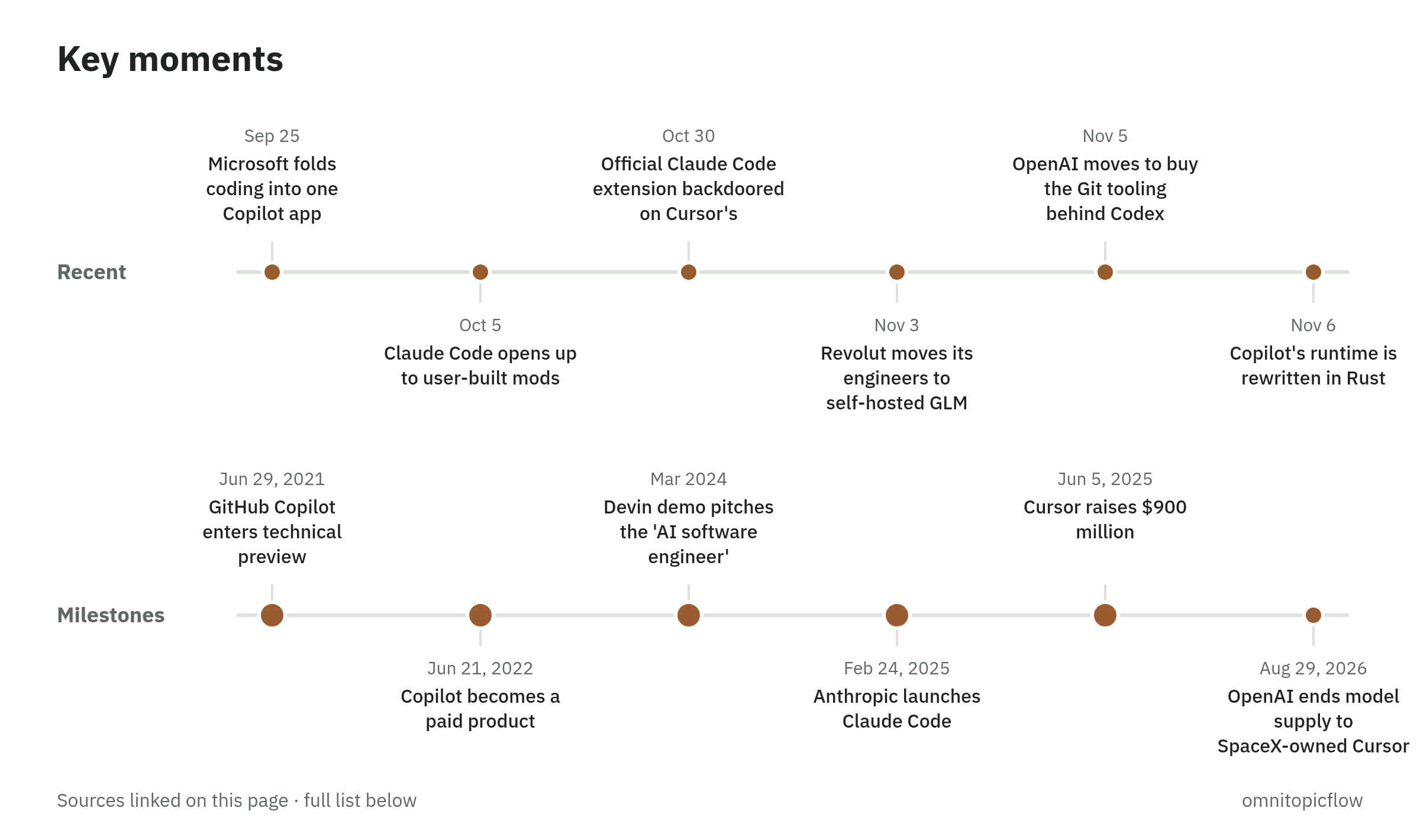
- Nov 6 — Copilot's runtime is rewritten in Rust: About 400,000 to 450,000 lines of production TypeScript in the GitHub Copilot runtime were ported to Rust. The goal was to escape Node.js and V8 and have one agent harness that many products can embed.
- Nov 5 — OpenAI moves to buy the Git tooling behind Codex: OpenAI said it will acquire Pierre Computer Company, whose Trees and Diffs already run inside the Codex app, and bring its Code Storage into Codex. The deal extends OpenAI's coding push from the agent into the Git workflow around it.
- Nov 3 — Revolut moves its engineers to self-hosted GLM: Revolut shifted the coding work of about 2,000 engineers to self-hosted GLM and made Claude Code and Codex the exception. It is a large, named case of a company leaving the leading agents on cost, at a reported tenth of its former bill.
- Oct 30 — Official Claude Code extension backdoored on Cursor's marketplace: The Claude Code for VS Code extension on the Cursor Marketplace carried an SSH backdoor for nearly 12 hours, pushed through Anthropic's verified account. It showed that coding tools themselves had become a supply-chain target.
- Oct 5 — Claude Code opens up to user-built mods: Anthropic let users extend Claude Code with JavaScript and TypeScript mods that watch session events, step into tool calls and add panels. Within weeks the community was shipping its own add-ons, turning the tool into a platform.
- Sep 25 — Microsoft folds coding into one Copilot app: Microsoft relaunched Copilot as a single app for chat, coding and agents. Coding stopped being a separate developer product at Microsoft and became one mode of its main AI app.
- Aug 29 — OpenAI ends model supply to SpaceX-owned Cursor: After SpaceX bought Cursor, OpenAI said it would cut off access on November 12, 2026 and withhold future models. It was the first time a leading model maker pulled out of a major coding tool over who owned it.
Earlier milestones
- Jun 5, 2025 — ★ Cursor raises $900 million: Cursor's $900 million Series C showed that an AI-first code editor from a startup could challenge the incumbents and draw big money.
- Feb 24, 2025 — ★ Anthropic launches Claude Code: Anthropic released Claude Code alongside Claude 3.7 Sonnet, moving AI coding from the editor into the terminal, where the agent edits files and runs commands itself.
- Mar 2024 — ★ Devin demo pitches the 'AI software engineer': Cognition's Devin demo shifted the conversation from autocomplete to agents that take a whole task and work through it alone.
- Jun 21, 2022 — ★ Copilot becomes a paid product: Copilot left preview and became generally available as a subscription, showing that developers would pay for AI code suggestions.
- Jun 29, 2021 — ★ GitHub Copilot enters technical preview: GitHub and OpenAI put an AI pair programmer inside VS Code, suggesting whole lines and functions. It was the first AI coding tool to reach developers at scale.
Key numbers
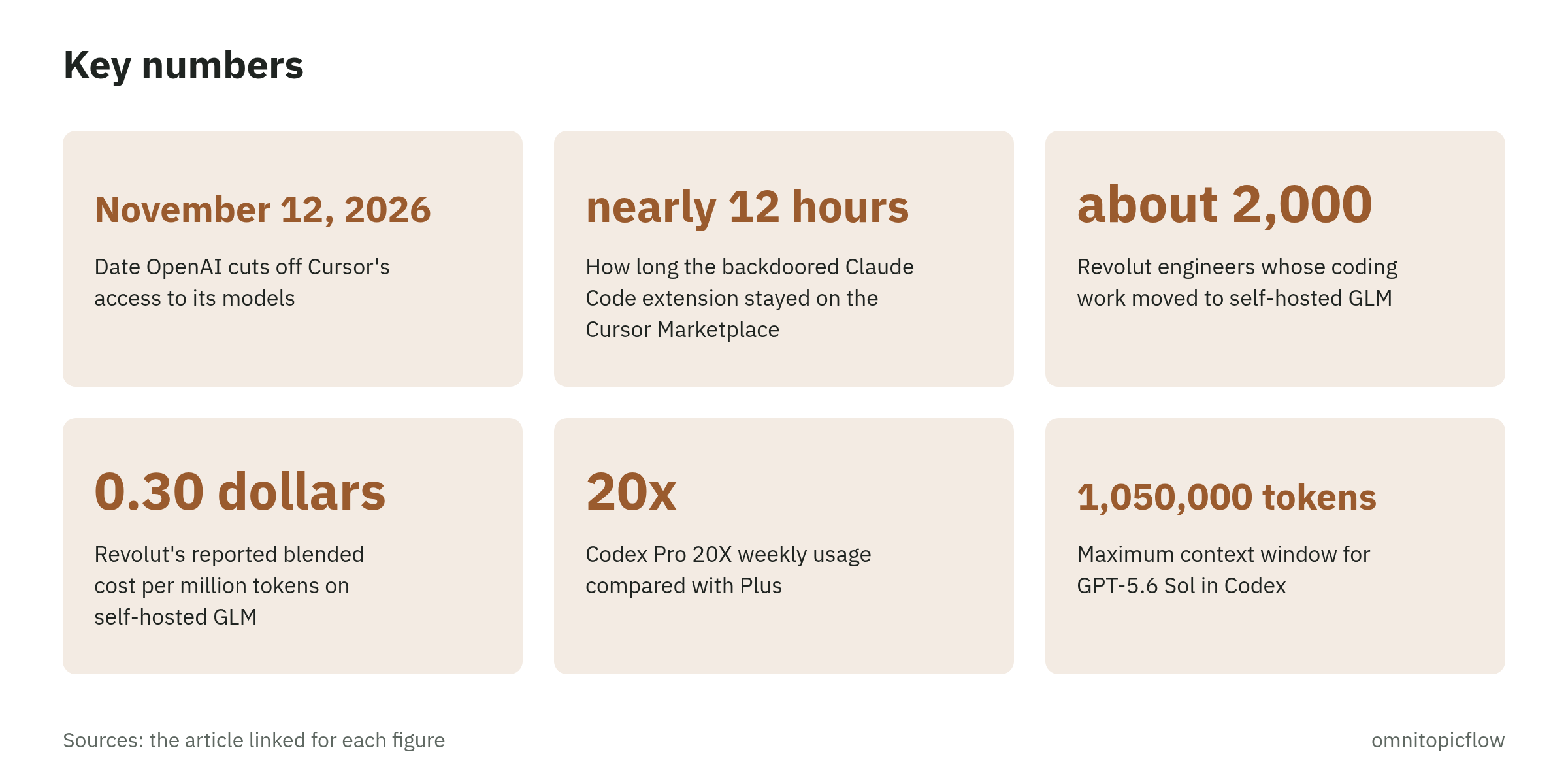
- Date OpenAI cuts off Cursor's access to its models: November 12, 2026
- How long the backdoored Claude Code extension stayed on the Cursor Marketplace: nearly 12 hours
- Revolut engineers whose coding work moved to self-hosted GLM: about 2,000
- Revolut's reported blended cost per million tokens on self-hosted GLM: 0.30 dollars
- Codex Pro 20X weekly usage compared with Plus: 20x
- Maximum context window for GPT-5.6 Sol in Codex: 1,050,000 tokens
- Share of the Claude Code team's own code written by Claude: about 90%
- How often Claude Code built a solution itself instead of picking a tool, in a 16,893-run study: 19%
Stories in progress
- Cursor after SpaceX: The acquisition turned a popular editor into a contested asset. OpenAI is ending model access on November 12 and will not ship future models to Cursor, while Cursor pushes into code hosting with Origin and now sits inside an X bundle with Grok. The open question for its users is which frontier models will still be in the model picker after the cutoff.
- Claude Code turns into a platform: Claude Code now reads AGENTS.md when no CLAUDE.md exists, runs groups of cloud agents under Projects, and accepts mods written in JavaScript or TypeScript. A busy community has filled the gaps with plugins for parallel sessions, stuck commands, review inboxes and usage widgets, which shows both how many people live inside it and how much they still want to change. The newest add-ons assume people run more than one agent: Heirmos keeps a shared memory for Claude Code and Codex, and OpenQodex sends an agent's changes to a separate Claude Code or Codex process for review.
- Usage limits and quiet model changes: Limits have become a product feature in their own right, and on November 2 OpenAI said ChatGPT and Codex will draw from one allocation pool. Anthropic extended a 50% weekly boost to August 31 while saying demand was straining capacity, and OpenAI pointed out that Codex's 20X plan means 20 times the weekly allowance, where Claude's 20X applies to the five-hour window. Users suspect the other lever is reasoning effort: one analysis found median reasoning per request on Fable 5 fell 21.9% from July to August, and an apparent server-side A/B test lowered effort for some sessions.
- Agents as an attack surface: As agents get shell access and marketplaces, the failures look less like bad code and more like supply-chain incidents. Researchers bypassed Claude Code's Auto Mode with a booby-trapped website in 60 to 80% of a small sample, Wiz showed a Copilot-reviewed fix in a Snowflake repository that still let an issue title run commands, and the Cursor Marketplace extension backdoor put an attacker's SSH key on developers' machines. Other software can now reach agents too: a November 3 report says Postman 12.33.4 added user-scope plugins to Codex and Claude Code, with a Codex startup hook bringing in the postman:api-engineer skill for ordinary API work as well as explicit Postman requests.
What to watch
- Which models Cursor will offer once OpenAI's access ends on November 12, and whether developers follow the models or the editor.
- How attackers reached Anthropic's verified Cursor Marketplace account, and what marketplaces change in how they vet extension updates.
- Whether other large engineering teams follow Revolut onto self-hosted models, and whether the savings it reports hold up as more companies try it.
- Whether OpenAI explains the reports of Codex data sharing switching back on, and how many users are affected.
- What Microsoft finally charges for the new Copilot app, and whether its Code mode pulls users away from GitHub Copilot in the editor.
Sources
- [GitHub Copilot 런타임 코드베이스 전체를 Rust로 이식한 이유와 방법 [영상]](https://www.youtube.com/watch?v=PLMOVlZC4eU)
- OpenAI, Pierre Computer Company 인수 예정
- Revolut, 자체 호스팅 GLM으로 전환
- Anthropic VS code extension on Cursor backdoored for nearly 12 hours
- Claude Code 모드(mod) 시작하기
- Microsoft thinks its new Copilot ‘super app’ will be as influential as Office
- SpaceX의 Cursor 인수 이후 OpenAI가 내린 결정
- Cursor raises $900 million)
- Anthropic launches Claude Code)
- Devin demo pitches the 'AI software engineer'
- Copilot becomes a paid product
- Codex의 20X는 주간 사용량도 실제 20배, Claude는 5시간 한도만 20배
- Codex에서 GPT-5.6 Sol의 1M 토큰 컨텍스트 윈도우 활성화하기
- Claude Code 팀의 코드 리뷰 방식
- Claude Code,Codex,Cursor는 어떤 도구를 선택할까? 1만7천 회 실행 분석


Comments
Post a Comment
Please read our comment policy before commenting.