Amazon: Latest News and Where It Stands

Amazon blocks rival AI shoppers while pushing Alexa into text messages and a new wave of Echo hardware
Updated November 7, 2026
Jeff Bezos founded Amazon in 1994 as an online bookstore. It has since grown into a retailer selling nearly every consumer product, with large businesses in cloud computing through AWS, online advertising and streaming. Its best-known products include Prime, Kindle e-readers, Echo speakers with Alexa, and Fire TV.
Closing the door on outside agents, opening it for Alexa
Amazon's position on AI shopping agents is now clear enough to describe: keep other companies' agents off the store and put its own in more places. On November 6 it said shoppers will be able to text Alexa for buying help, starting by invitation in the US and later reaching millions of users. About six weeks earlier, Meta's Muse agent had been blocked from Amazon.com, with users told that an unauthorized agent breaks the site's conditions of use. That block followed a US appeals court decision lifting the injunction that had kept Perplexity's Comet out, which leaves the site's terms as the visible line of defense. Walmart went the other way on October 21, with technology that lets agents buy for customers under spending and approval controls.
The hardware is being rebuilt around the same assistant. The October 28 lineup added an Alexa Photo Frame and the Echo Time clock, an Echo Dot with a built-in Eero Wi-Fi extender, an Echo Studio with a camera that gives Alexa+ visual features, and a $500 Echo Show 16 with an AI-generated interface. Two weeks before, devices chief Panos Panay had described ambient AI devices that anticipate needs and make apps less necessary. Owners are not all sold on the idea. By November 3, CNET was publishing instructions for removing AI filler from Echo Show screens, and these launches arrive after an August price increase of up to 60 percent that Amazon blamed on memory and storage costs.
Behind the assistant sits a growing compute bill and growing local resistance. In August Amazon committed to another 2 million Nvidia GPUs over two years, then on October 19 released TorchNeuron, a tool meant to loosen Nvidia's hold on PyTorch so developers can run on other chips, including its own. It also agreed that day to fund 12 small reactors with X-energy at a former Indiana coal plant. Data center opposition has followed the build-out: a $1B plan to answer critics drew praise for ending NDAs and complaints that it plays down pollution, and a $20 million Colorado River water program did not settle how much water the company actually uses.
Key moments
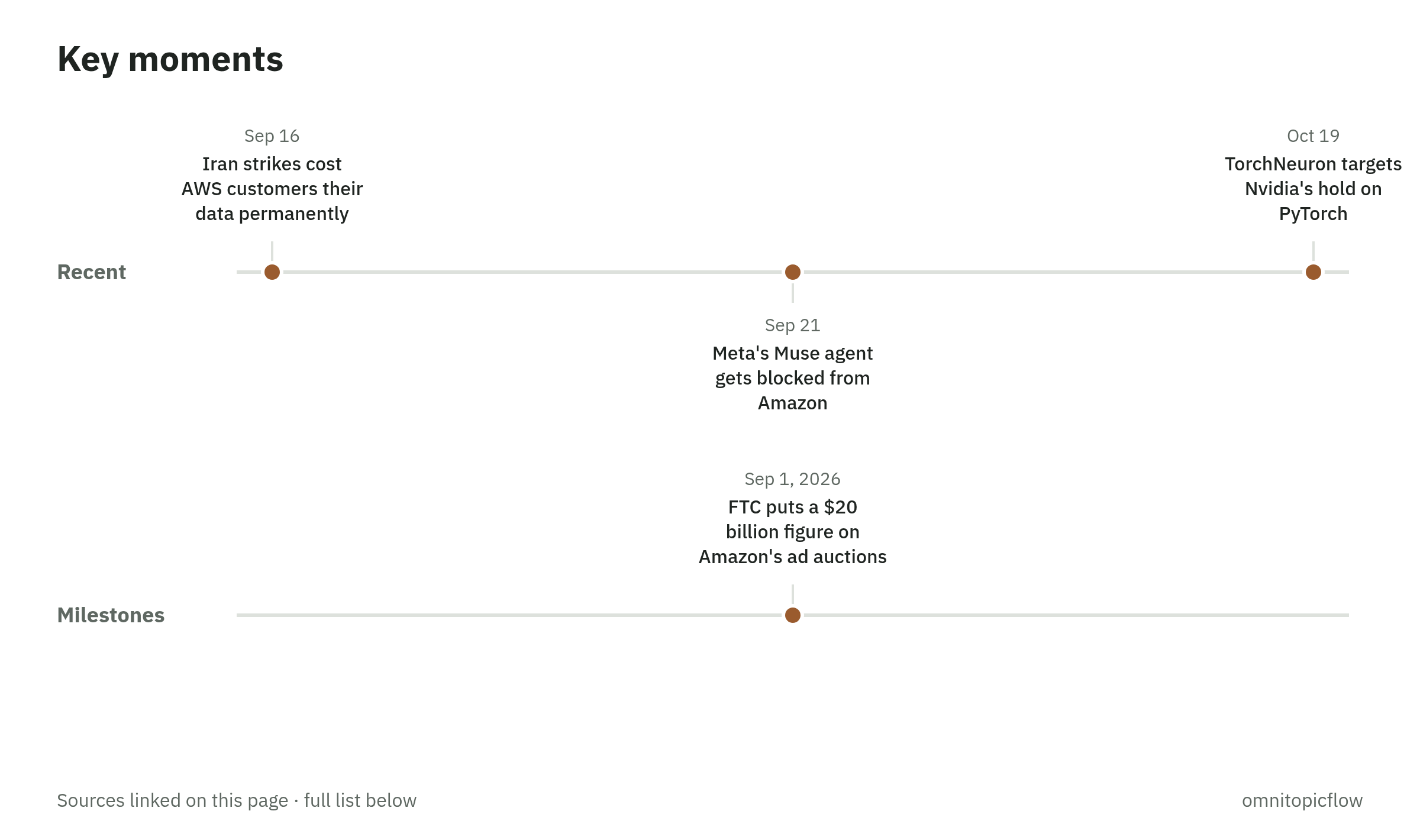
- Oct 19 — TorchNeuron targets Nvidia's hold on PyTorch: Amazon released a developer tool meant to help PyTorch apps run on alternative chips, including its own. It moved the contest with Nvidia from hardware purchases to the software developers use every day.
- Sep 21 — Meta's Muse agent gets blocked from Amazon: Muse users began seeing a popup saying an unauthorized agent violates Amazon's conditions of use. The block drew a sharp line between Amazon's own shopping AI and agents built by its rivals.
- Sep 16 — Iran strikes cost AWS customers their data permanently: War damage to Amazon data centers went beyond what AWS services are designed to withstand, and some customer data was lost for good. It showed that cloud resilience has a physical limit in a war zone.
- Sep 1 — FTC puts a $20 billion figure on Amazon's ad auctions: The FTC alleges Amazon replaced real auction results with higher prices it set itself, illegally earning $20 billion. The claim puts the mechanics of Amazon's advertising business at the center of a government case.
Key numbers
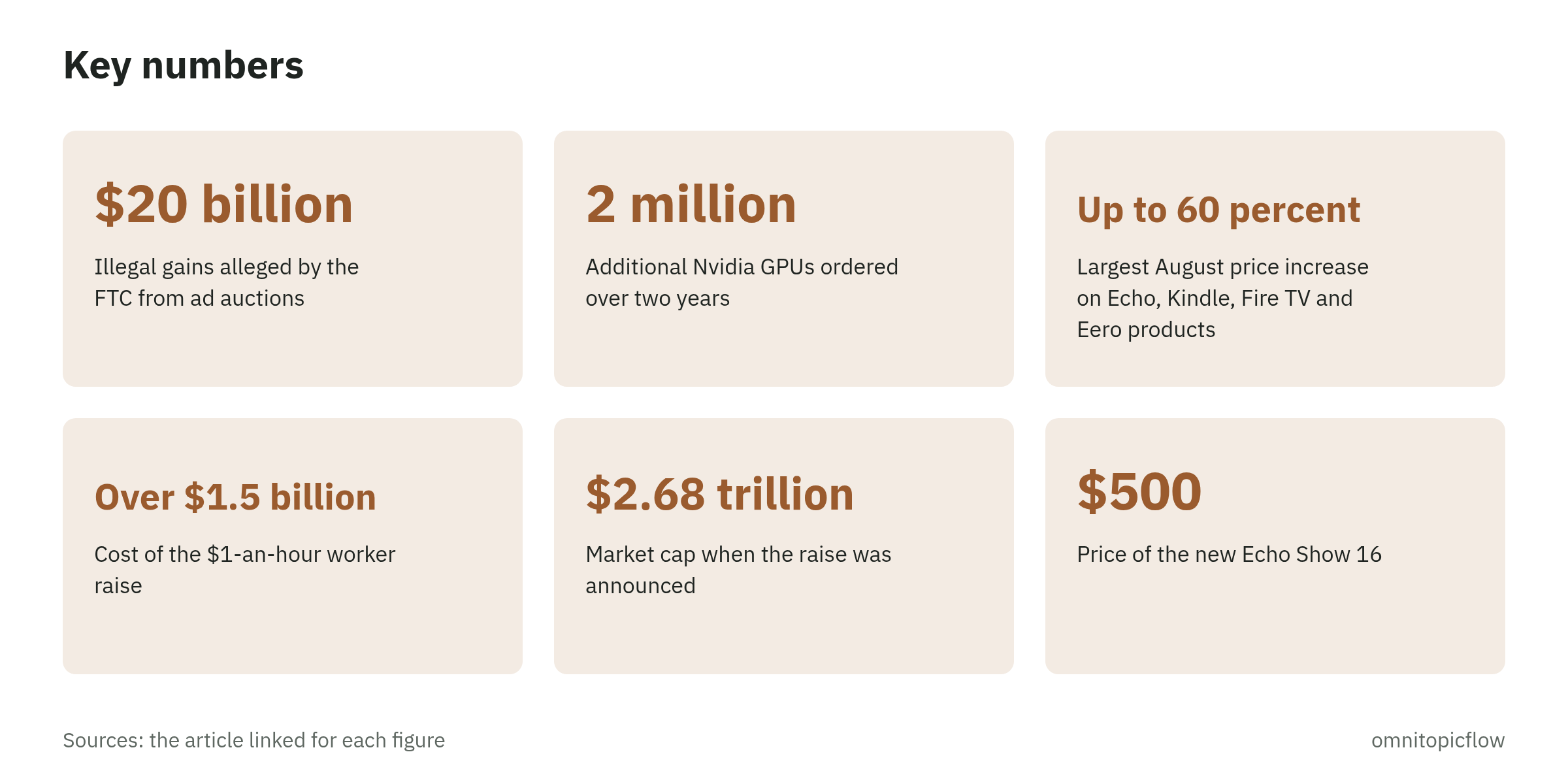
- Illegal gains alleged by the FTC from ad auctions: $20 billion
- Additional Nvidia GPUs ordered over two years: 2 million
- Largest August price increase on Echo, Kindle, Fire TV and Eero products: Up to 60 percent
- Cost of the $1-an-hour worker raise: Over $1.5 billion
- Market cap when the raise was announced: $2.68 trillion
- Price of the new Echo Show 16: $500
- Power from the X-energy reactors planned in Indiana: Nearly 1 gigawatt
- Plan to answer data center opposition: $1B
Stories in progress
- Who gets to shop on Amazon: A US appeals court lifted the order against Perplexity's Comet, and Amazon then shut out Meta's Muse under its conditions of use. Walmart's decision to welcome agents gives shoppers a direct comparison. Amazon's own option is Alexa, now reachable by text, and it is also building shopping into Prime Video with a Lens-powered Shop the Scene feature.
- Alexa spreads beyond the subscription: In August Alexa+ became free on compatible Fire TV devices in the US, with no Prime membership needed, and in September it reached India with Hindi support during an early access period. The late October devices extend it to a photo frame and a bedside clock. The harder test is at home, where the camera on the new Echo Studio comes with a kill switch and some Echo Show owners are already hunting for ways to turn AI content off.
- Buying from Nvidia while working around it: Amazon tripled its Nvidia order in August citing surging demand, yet TorchNeuron is aimed squarely at the software habits that keep developers on Nvidia GPUs. Google released a similar PyTorch tool one day later, so the pressure on that stronghold no longer comes from Amazon alone.
- Scrutiny from courts, regulators and readers: The FTC and 22 states sued over what they call a secret ad surcharge, weeks after Amazon's new terms moved customer disputes to arbitration with a class action waiver. Four women have also sued, saying the company denied them basic accommodations during pregnancy and fired them. Separately, 404 Media hid an AirTag in a rare book and traced it to an Amazon AI training site, prompting reports that the company is destroying rare texts for model training.
What to watch
- Does texting Alexa move past invitation-only US access at the promised scale, and do shoppers actually let it complete purchases?
- Can Amazon's terms keep outside agents off the site after the Perplexity ruling, and does Walmart's open approach draw shoppers or agent makers away?
- How much of the FTC's $20 billion allegation survives in court, and does the case change how Amazon runs its ad auctions?
- Will Amazon publish how much water its data centers use, as scrutiny continues after its $1B plan and the end of its NDAs?
- Do the higher device prices hold if memory and storage costs ease?
Sources
- Amazon is taking its biggest shot at Nvidia yet with new TorchNeuron dev tool
- Amazon doesn’t trust Meta’s Muse AI agent
- Iran strikes on Amazon data centers caused permanent loss of customer data
- FTC alleges Amazon illegally made $20 billion by rigging billions of ad auctions
- Amazon just tripled its order of Nvidia chips over ‘surging demand’
- Amazon just hiked the prices for Echo, Fire TV, and Kindle products by up to 60 percent
- Amazon gives its workers a raise of $1 per hour
- Amazon’s $500 Echo Show 16 Wants to Be the Center of Your Home
- Amazon to fund 12 small nuclear reactors at former Indiana coal plant
- Amazon’s $1B plan to combat data center backlash draws more backlash


Comments
Post a Comment
Please read our comment policy before commenting.