Apple: Latest News and Where It Stands

Apple's record iPhone quarter comes with an open-ended Duo shortage and memory costs running into 2027
Updated November 7, 2026
Apple designs the iPhone, Mac, iPad, Apple Watch and AirPods, and runs the software and services that tie them together, from iOS and macOS to the App Store and iCloud. Steve Jobs, Steve Wozniak and Ronald Wayne founded the company in 1976, and it is headquartered in Cupertino, California. The iPhone remains its defining product.
Record iPhone sales, tight supply and a rising memory bill
Two months after John Ternus replaced Tim Cook as CEO on September 1, Apple's sales look strong and its constraints look stubborn. The fourth-quarter report on November 2 showed $57.58 billion in iPhone revenue, up 17 percent from a year earlier and a record, even though the latest refresh had no new standard model. Inventory jumped 154% to $14.5 billion as Apple warned that unprecedented memory chip costs will keep rising, and Ternus said on the earnings call that price hikes and shortages will continue into 2027. He also told Reuters that Apple is 'not able to predict' when iPhone Duo supply will catch up. How much of this reaches buyers is still open, but new hardware is already getting costlier: reviews flag higher prices on the iPad mini and the M6 iMac, and a Weibo leak says the base iPhone 18 will cost more too.
Software moved quickly in the same week. With iOS 27.3 on November 3, Apple told developers they can bring Siri AI's new features to 'all apps', letting the assistant act across third-party software with a user's personal context, and the waitlist for the Siri AI beta on iOS 27 is gone. On the earnings call Apple hinted at revenue 'opportunities' from third-party AI apps without spelling them out, while a separate report says it is sharply cutting what its engineering teams spend on AI. The friction is still about consent rather than capability. Siri Recap and Live Rewind, which let the Apple Watch Series 12 and Ultra 4 recap and rewind conversations, entered the watchOS 27.3 developer beta as opt-in features. From version 27.3, Apple will also check iCloud items shared with anyone who has the link for 'harmful content'.
App Store rules are shifting on two tracks. The money track has been running since August: on August 14 Apple asked a US federal judge to let it charge up to 15% on purchases made through external links, and four days later it replaced the per-install fee in the EU with a 5% commission on apps distributed outside the App Store. The newer track is about who may use what. On November 3 Apple said dating apps and AI companions offering sexual or romantic content will need an 18+ rating, and that apps sharing location will have to disclose it. Security also returned to the news on November 2, when Germany said lawmakers' iPhones may have been hacked with spyware after Apple sent warnings to lawmakers and a filmmaker.
Key moments
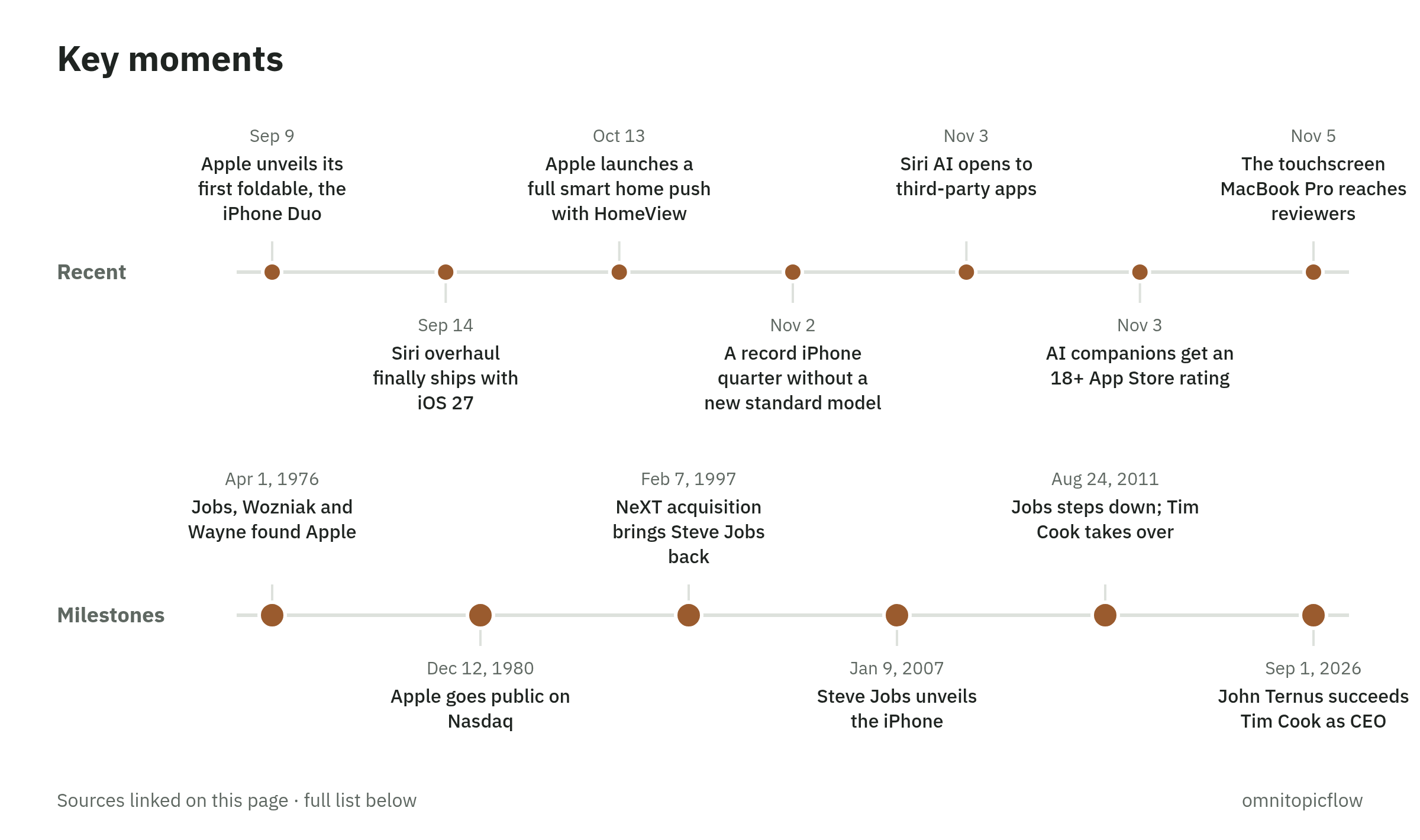
- Nov 5 — The touchscreen MacBook Pro reaches reviewers: Engadget's review of the MacBook Pro with PROLED XDR display found it lighter and brighter, with a touchscreen that doesn't add much at a much higher price. Weeks of touch Mac reports now have a real product to be judged against.
- Nov 3 — AI companions get an 18+ App Store rating: Apple's new App Store rules require 18+ ratings for dating apps and AI companions offering sexual or romantic content. It places AI companions under the same age gate as dating apps.
- Nov 3 — Siri AI opens to third-party apps: With iOS 27.3, Apple told developers they can bring Siri AI's new features to all apps. That moves the rebuilt assistant from Apple's own software toward actions across the wider App Store.
- Nov 2 — A record iPhone quarter without a new standard model: Apple reported $57.58 billion in fourth-quarter iPhone revenue, up 17 percent from a year earlier, even though its latest refresh skipped a standard iPhone. The result showed how much demand the rest of the lineup can carry on its own.
- Oct 13 — Apple launches a full smart home push with HomeView: At its 'Welcome Home' event, Apple introduced the HomeView hub and a broad home lineup built with partners including LG. After years of piecemeal HomeKit efforts, the home became a product category in its own right.
- Sep 14 — Siri overhaul finally ships with iOS 27: The long-delayed rebuild of Siri arrived as Siri AI, able to use personal context and act inside apps. It is the centerpiece of Apple's case that AI belongs on its own devices.
- Sep 9 — Apple unveils its first foldable, the iPhone Duo: After years of rumors, Apple entered the foldable category with a wider form factor than early rivals. It was the first big launch of the Ternus era and gave the iPhone line a new ultra-premium tier.
- Sep 1 — ★ John Ternus succeeds Tim Cook as CEO: Apple's first CEO change since 2011 put a hardware engineering veteran in charge, with Cook staying on as executive chairman. It marks the end of the era that began when Cook replaced Jobs.
Earlier milestones
- Aug 24, 2011 — ★ Jobs steps down; Tim Cook takes over: Jobs resigned as CEO for health reasons and Tim Cook succeeded him, opening the era that has run Apple ever since.
- Jan 9, 2007 — ★ Steve Jobs unveils the iPhone: The first iPhone redefined the smartphone and became the product that drives most of Apple's business.
- Feb 7, 1997 — ★ NeXT acquisition brings Steve Jobs back: Buying NeXT returned Jobs to Apple and supplied the software foundation for its later operating systems.
- Dec 12, 1980 — ★ Apple goes public on Nasdaq: Apple's IPO on Nasdaq turned the young personal-computer maker into a public company.
- Apr 1, 1976 — ★ Jobs, Wozniak and Wayne found Apple: Apple Computer Company began as a three-person partnership building personal computers.
Key numbers
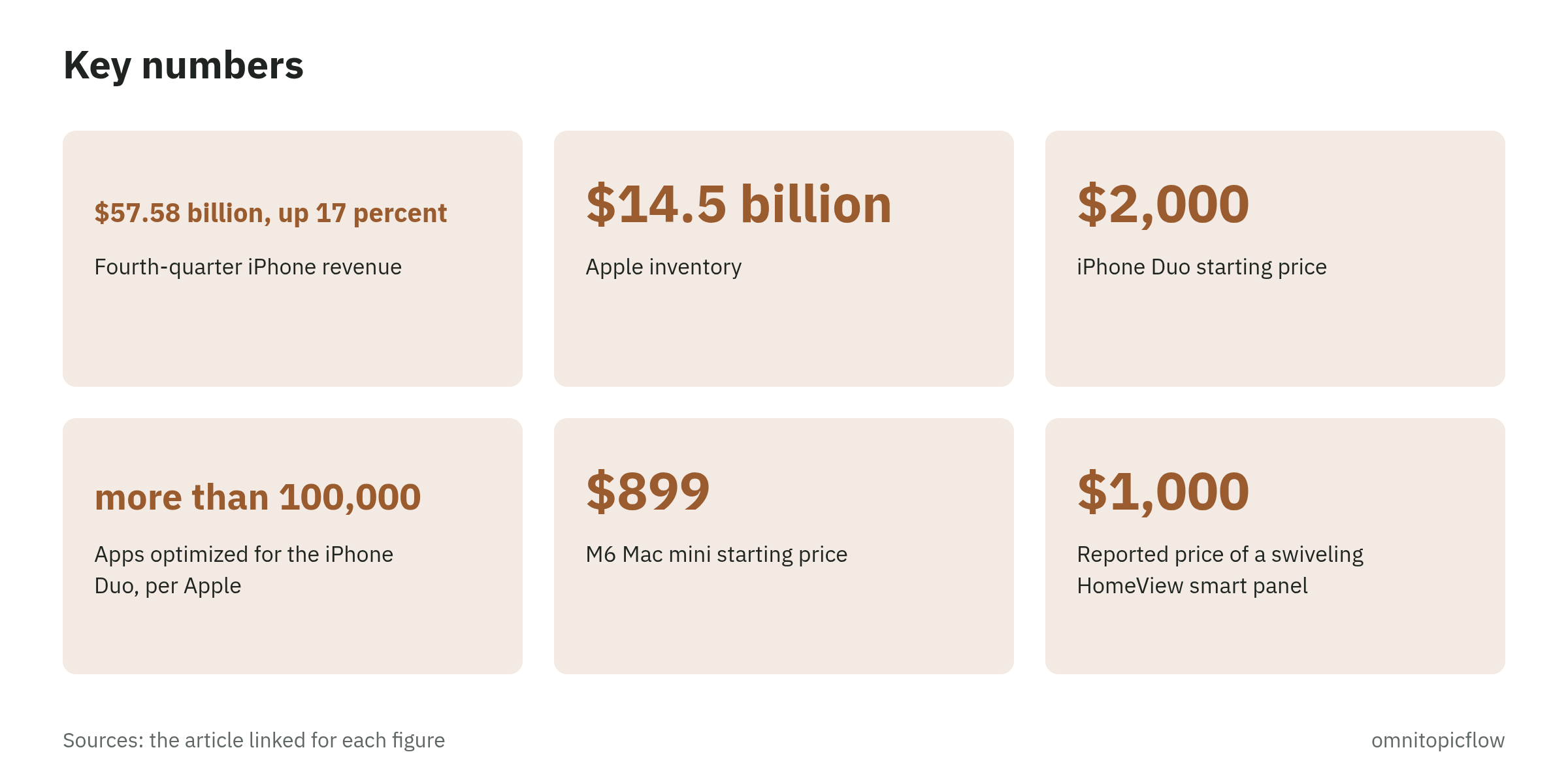
- Fourth-quarter iPhone revenue: $57.58 billion, up 17 percent
- Apple inventory: $14.5 billion
- iPhone Duo starting price: $2,000
- Apps optimized for the iPhone Duo, per Apple: more than 100,000
- M6 Mac mini starting price: $899
- Reported price of a swiveling HomeView smart panel: $1,000
- Proposed US commission on external-link purchases: up to 15%
- New EU commission on apps distributed outside the App Store: 5%
Stories in progress
- The iPhone Duo outruns its supply: Apple unveiled its first foldable on September 9 at a starting price of $2,000, and preorders opened October 16. Supply has not caught up: Ternus has no timeline for when the constraints will lift, even as US carriers advertise up to $1,200 off with 36-month plans. Developers moved faster, with Apple counting more than 100,000 apps built for the foldable on November 6, two weeks into sales, while questions about the durability of its display have followed it since early October.
- Apple finally commits to the smart home: At its 'Welcome Home' event on October 13, Apple laid out a sweeping home lineup, with its own take on home security starting in December. Bloomberg's Mark Gurman had reported on a camera that would deliver text descriptions of events instead of video, but strings in the HomeView 27.2 code, found by a Reddit user, hint at a security camera mode with motion detection, live streaming and recording. Reports also put a $1,000 price on what comes next: ZDNet describes a HomeView Ultra with a robotic arm and 9-inch display, and Ars Technica a home robot due in 2027 for FaceTime and switching on lights.
- M6 reaches the Mac line, and touch arrives at the top: The M6, Apple's first 2-nanometer chip, debuted on August 25 in a Mac mini starting at $899, and a 14-inch MacBook Pro and an iMac followed in late October around the 'Pro and Tell' event in Los Angeles, alongside an OLED iPad mini. Engadget's review of the MacBook Pro with PROLED XDR display calls it lighter and brighter but says the touchscreen doesn't add much for a much higher price, and new reports say touch will become standard on premium MacBook Pros. Three more iPads are reportedly due in early 2027.
- Rewriting App Store rules, from fees to age gates: Instead of one global fee policy, Apple is negotiating market by market: a proposed commission of up to 15% on external-link purchases in the US, a 5% fee replacing the per-install charge in the EU, and redesigned tracking prompts in Germany. Each of those changes keeps Apple's commission in place while altering how it is collected. The November rules add a different kind of control, requiring developers to declare whether their apps enable dating between real people or with AI companions so Apple can apply the proper age rating.
What to watch
- Can iPhone Duo supply catch up with demand, and will the display durability complaints grow into a repair or warranty issue?
- How much of the rising memory bill reaches buyers in 2027, starting with the base iPhone 18 price that leakers expect to go up?
- When does Siri AI move beyond its English beta, and what form do the third-party AI 'opportunities' Apple hinted at take?
- How will buyers respond when the smart home lineup arrives in December, given that the AI camera features already require paid plans of up to $60 a month?
- Will the US court accept Apple's proposed commission on purchases made through external links?
Our coverage
- Apple App Store Age Ratings Put AI Companions in the Same 18+ Box as Dating Apps
- Apple HomeView Security Camera Mode Spotted in 27.2 Code, With Privacy Signals Built In
Sources
- MacBook Pro with PROLED XDR Display review: Lighter, brighter, but the touchscreen doesn't add much
- Apple restricts dating apps and AI companions to users 18 and up
- Apple starts giving Siri AI access to third-party apps
- Apple set an iPhone sales record even without a new standard iPhone
- HomeView and More: Everything Apple Announced at Its ‘Welcome Home’ Event
- With iOS 27, I’m actually using Siri again
- Apple unveils its first foldable, the iPhone Duo
- John Ternus is now the CEO of Apple
- Jobs steps down; Tim Cook takes over
- Apple’s inventory surges 154% as memory chip costs climb
- Apple's long-rumored foldable becomes reality with the $2,000 iPhone Duo
- The iPhone Duo has more than 100,000 optimized apps, Apple says
- Apple’s latest Mac Mini runs on a new M6 chip, and starts at $899
- HomeView with an arm? Apple reportedly plans $1,000 swiveling smart panel
- Apple proposes to take a 15% cut of purchases made outside the App Store
- Apple overhauls its EU App Store fees, loosens rules for alternative app stores


Comments
Post a Comment
Please read our comment policy before commenting.