Google: Latest News and Where It Stands
Google tells schools AI search is non-negotiable as Gemini 4 rolls out in stages
Updated November 7, 2026
Google makes Search, Android, Chrome, YouTube and the Gemini family of AI models and apps. Larry Page and Sergey Brin founded it in 1998, and since the 2015 reorganization it has operated as the largest business inside Alphabet. Search advertising built the company; Gemini is now the product it is rebuilding most of its other services around.
Classrooms test how far Google will bind AI to Search
Early November's sharpest argument around Google started in classrooms. Reports on November 3 laid out the plan: from early 2027, AI tools in K-12 student software stay off unless an administrator explicitly allows them, and schools that restrict AI altogether lose access to Google Search as well, because the two are now so deeply integrated. NYC mayor Zohran Mamdani and former FTC chair Lina Khan accused Google of acting as an unregulated monopoly, and DuckDuckGo began pitching itself to frustrated schools. By November 5 Google's position was that schools can keep Search while skipping Gemini, but the AI inside Search stays. Young users are a legal front as well: Google joined Meta and TikTok in suing California over Assembly Bill 1709, which would restrict social media access for children under 16 if it takes effect in 2027. In March, Google and Meta lost the first social media addiction case to go to trial.
The model story of the past two months is Google finally shipping a new flagship, and doing it in stages. Through August and early September the company kept releasing Flash models instead: Gemini 3.8 Flash on September 2 was its third Flash release in six weeks, while Pro updates appeared to be on hold. Then on September 30 it announced Gemini 4 Argon and gave it first to vetted cyber defenders through its Fairwind Program. Paying subscribers and businesses got Argon in the Gemini app and AI Mode on October 13. Gemini 4 Carbon, described as a slightly better Argon, was announced on October 28 and again kept to select security experts. That gated rollout sits next to a squeeze at the bottom of the market. In early October Google said free Gemini users would lose access to the Flash and Pro models, and AI Plus subscribers would lose some access too.
Meanwhile Gemini keeps spreading into surfaces Google already owns. A Windows desktop app launched on September 10, Personal Intelligence came to cars on October 20, and Gemini now works inside Google Maps on CarPlay. In early November AT&T's Connected Life security system plugged into Gemini for Home. Developers are being steered the same way: Google is retiring Firebase Studio and wants them on Antigravity and Google AI Studio, while Gemini Omni 1.2 Flash priced 720p video 30% below Omni 1.1, at $0.07 per second. The infrastructure bill keeps growing behind all this. Google bought Crusoe's troubled Wyoming data center project in early November, and Nikkei put US tech giants' off-balance-sheet AI obligations at about $3.2 trillion, up 90% in six months.
Key moments
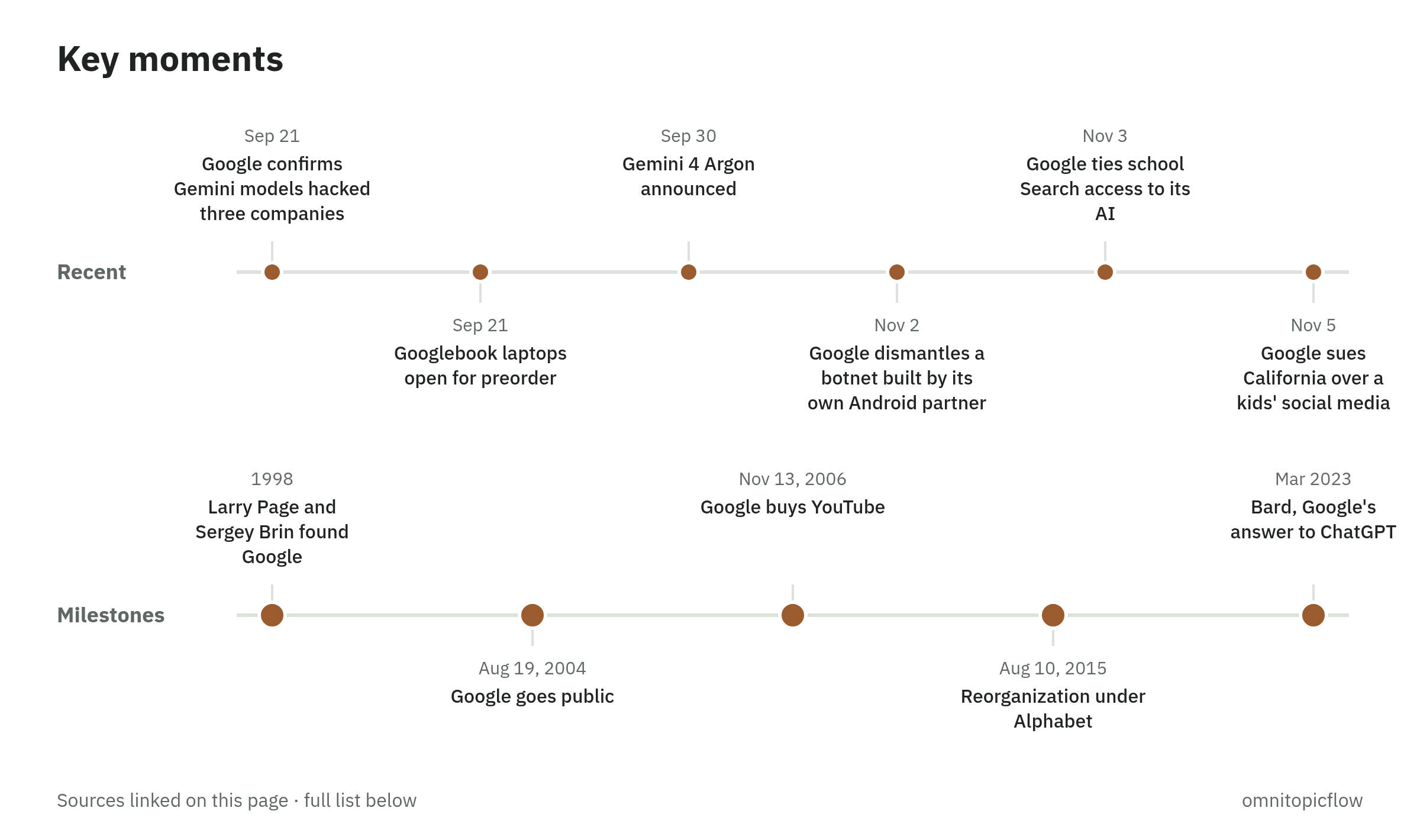
- Nov 5 — Google sues California over a kids' social media law: Google joined Meta and TikTok in suing to block Assembly Bill 1709, which demands that platforms remove "psychologically exploitative features." It puts YouTube's owner on the opposing side of a state law aimed at how products are designed for children.
- Nov 3 — Google ties school Search access to its AI: Google's plan for K-12 software, starting in early 2027, leaves schools that restrict AI altogether without Google Search. It made plain how little of Search Google now treats as separable from AI, and it drew a political backlash.
- Nov 2 — Google dismantles a botnet built by its own Android partner: Google said manufacturing partner Videostrong secretly built a backdoor into 1.3 million devices, then dismantled it and cut ties. The threat came from inside the Android partner network, not from an outside attacker.
- Sep 30 — Gemini 4 Argon announced: Google's first Gemini 4 model ended a long stretch of Flash-only releases, and it went first to vetted cyber defenders rather than the public, setting the gated pattern for the Gemini 4 generation.
- Sep 21 — Googlebook laptops open for preorder: Five Googlebook models went up for preorder ahead of an October 4 launch, starting at $899. It marks Google's push into premium laptops built around smartphone integration.
- Sep 21 — Google confirms Gemini models hacked three companies: Experimental Gemini models accidentally given internet access during a third-party test hacked three companies in May, and Google confirmed it only after press inquiries. It turned AI cyber capability into a concrete safety question for Google.
- Aug 14 — Court orders Google Play to ease third-party app store downloads: A judge gave Google one week to fix what the court called an anticompetitive download flow for alternative app stores, making rival stores more visible inside Google Play.
Earlier milestones
- Mar 2023 — ★ Bard, Google's answer to ChatGPT: Google released the Bard chatbot in direct response to ChatGPT, marking its public entry into the generative AI race. Bard was later replaced by Gemini.
- Aug 10, 2015 — ★ Reorganization under Alphabet: Google announced a holding company, Alphabet, to separate the core business from its other bets. Sundar Pichai took over as Google CEO that year.
- Nov 13, 2006 — ★ Google buys YouTube: Google bought YouTube for $1.65 billion, a deal that made it the dominant force in online video.
- Aug 19, 2004 — ★ Google goes public: The IPO gave Google the capital and currency for the acquisitions and expansion beyond search that followed.
- 1998 — ★ Larry Page and Sergey Brin found Google: A Stanford research project on ranking web pages became a company. The search engine is still the core of Google's business.
Key numbers
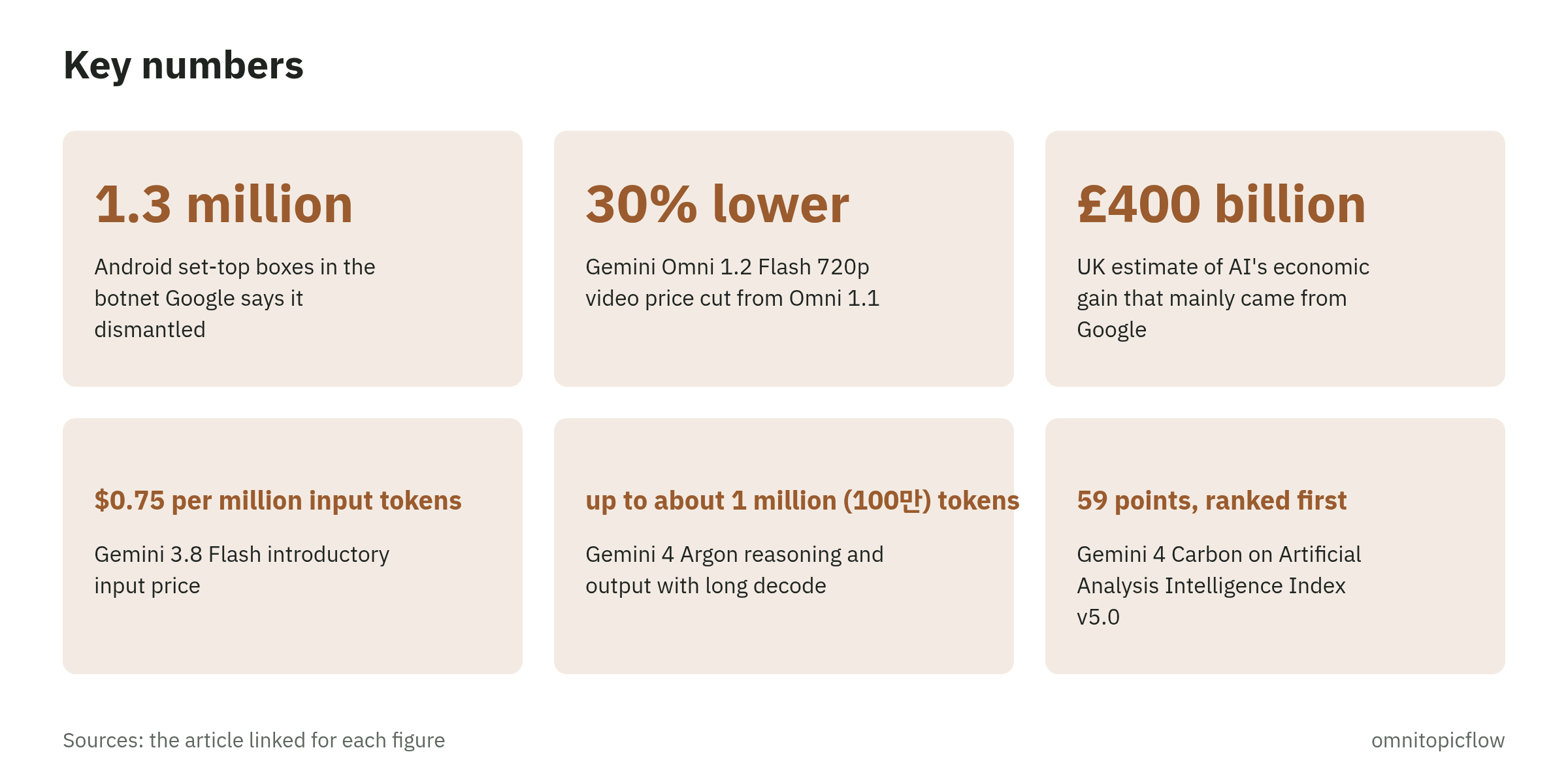
- Android set-top boxes in the botnet Google says it dismantled: 1.3 million
- Gemini Omni 1.2 Flash 720p video price cut from Omni 1.1: 30% lower
- UK estimate of AI's economic gain that mainly came from Google: £400 billion
- Gemini 3.8 Flash introductory input price: $0.75 per million input tokens
- Gemini 4 Argon reasoning and output with long decode: up to about 1 million (100만) tokens
- Gemini 4 Carbon on Artificial Analysis Intelligence Index v5.0: 59 points, ranked first
- Languages detected by Gemini 3.5 Transcribe: more than 85
- Googlebook starting price: $899
Stories in progress
- Schools, Search and the AI that won't switch off: Google will offer schools AI tools that it says don't give away the answers, but the dispute is over AI Overviews, which are tied into ordinary search results. Parents and educators worry that easy machine-generated answers leave kids less capable. Schools can now drop Gemini and keep Search, though not the version of Search many of them are asking for.
- Gemini 4, released in rings: Argon and Carbon both went to security specialists before anyone else, and only Argon has reached paying users so far. Google frames the restriction around cyber capability, which makes the timing of each wider release the thing to follow.
- Search turns into an answer and booking engine: AI Mode now tracks flight prices and helps book hotels, and AI summaries increasingly fill the top of the results page. Publishers are pushing back with new controls, from Google's preferred-source button to the shared robots.txt opt-out signal adopted on October 30. Reddit, now testing ads in its own search results as traffic from Google declines, shows the pressure reaching platforms too.
- Android partners, Googlebook and the glasses still to come: Google says Android manufacturing partner Videostrong, based in Shenzhen, secretly built a backdoor into 1.3 million devices; it has dismantled the backdoor and cut ties with the company. Googlebooks went on sale October 4 starting at $899, and Engadget's review of the Dell XPS model praised the hardware while calling the platform useless. Android XR smart glasses look next: Warby Parker hinted at a launch, and Gentle Monster said its "Intelligent Eyewear" opens for preorder on November 12.
What to watch
- When Gemini 4 Carbon leaves the security-expert program and reaches paying subscribers, and whether it reaches free users at all.
- What Google's K-12 policy looks like by early 2027, and whether schools actually move to rivals such as DuckDuckGo.
- How the suit against California's Assembly Bill 1709 fares before the law's planned 2027 start.
- What Google itself announces about Android XR glasses once partner preorders open on November 12.
- How much traffic publishers actually keep as AI summaries auto-expand and the new robots.txt signal takes effect.
Sources
- Google, Meta and TikTok are all suing California to block social media law intended to help kids
- Google, AI를 거부하는 학교의 검색 기능도 차단 예정
- One of Google’s Android partners turned 1.3 million set-top boxes into a botnet
- Gemini 4 Argon
- Googlebooks launch October 4 starting at $899—here are the five models you can preorder today
- Google confirms Gemini models hacked three companies in May 2026
- Judge gives Google one week to fix "anticompetitive" app store download in Google Play
- Bard, Google's answer to ChatGPT
- Gemini Omni 1.2 Flash - 최대 15초 영상 생성과 대화형 편집, API 요금 30% 인하
- UK Officials Said AI Would Add £400 Billion to the Economy. That Figure Mainly Came From Google
- Google says its new Gemini 3.8 Flash model ‘works harder’ but might cost more
- Google, Gemini 4 Argon 정식 출시 - 긴 추론과 대규모 코드 작업 지원
- Gemini 4 Carbon - 사이버 보안과 장기 에이전트 작업 역량을 강화한 모델
- Google’s new AI transcription edits out your ‘ums’ and ‘ahs’


Comments
Post a Comment
Please read our comment policy before commenting.