Meta: Latest News and Where It Stands
Meta buys Conductor and gives Muse a voice as it sues California over under-16 limits
Updated November 7, 2026
Meta is the company behind Facebook, Instagram, WhatsApp and Messenger. It began as TheFacebook, a college social network started by Mark Zuckerberg, and renamed itself Meta Platforms when it widened its bet to virtual reality. Advertising across its apps pays for nearly everything else, including the Reality Labs hardware division (Quest headsets, Ray-Ban smart glasses) and a growing family of AI models and assistants.
One agent, many screens, and a rising legal bill
Meta's AI strategy now carries a single name. Muse, the personal agent launched on September 8, is built to book, buy and write on a user's behalf, and Meta has since pushed it onto almost every surface it controls. It added phone calls and its own email addresses for agents, arrived on iPad on October 7, and was shown running on the smart glasses unveiled at Connect, alongside a small screen-only gadget called Muse Charm. The first week of November brought real-time voice conversations, video chat with a customizable animated avatar for US users, and Spaces, which has the assistant build app-like tools such as a shopping hub or school dashboard inside Muse. Early demand was real: Muse reached No. 2 among US apps, and Appfigures estimates put it ahead of ChatGPT's early mobile pace in the US and Canada. On September 28 Meta packaged the same stack for businesses and hired MongoDB CEO CJ Desai to run the new enterprise platform. Older products are shifting around it. Edits, the CapCut rival, reached desktop as a Mac app, WhatsApp Events can now invite guests without accounts, and Quest 2 and Quest Pro get their last OS update by March 2027.
The models underneath were rebuilt in a hurry. Muse Spark, the first model from the revamped Superintelligence Labs, got a 1.3 update for long agent and coding sessions on September 2, and Meta offered developers an average discount of about 95% if they let their prompts and outputs feed future training. Muse Wonder and Muse Wonder Full followed on October 12, which Meta presents as its first frontier models. Three days later came Muse Spark Open, an open-weight model made with Apple to run locally on Apple silicon, though it needs roughly 1TB of RAM. On November 4 Meta added a product team by acquiring Conductor, whose software lets engineers deploy teams of agents across one project at the same time. With its third-quarter results on October 21, Meta said it would fund this buildout partly through a new class of non-voting shares that starts trading in 2027. The financing is drawing attention: Nikkei counts $3.2 trillion in off-balance-sheet AI obligations at big US tech firms, up 90% in six months, and Meta itself warned in early November that election backlash against data centers could make its expansion harder.
The cost column is growing just as quickly. Meta settled child-safety claims from 29 states on August 26 for a sum reported at $18 billion (Reuters put it at $16.68 billion) and agreed to a two-hour daily limit for teens that only parents can switch off. The third quarter absorbed $9.89 billion of that, and Meta noted that operating income would otherwise have been $22.89 billion. Weeks later a New Mexico judge ordered the company to pay $25 billion over claims that it misled users. Settling has not meant accepting new rules: in November Meta joined Google and TikTok in suing California to block Assembly Bill 1709, which would restrict social media access for children under 16. Advertising is under fire as well. Mark Cuban says Facebook knowingly runs AI ads that impersonate him to sell a fake diabetes treatment, and internal documents obtained by Reuters estimated that scam and banned-product ads would bring in $16 billion, about 10% of 2024 revenue. Muse has drawn its own scrutiny: Amazon blocked the agent from shopping on Amazon.com, Meta conceded it was “heavily inspired” by OpenClaw, and on October 30 US senators asked Meta how it handles privacy risks in its AI glasses.
Key moments
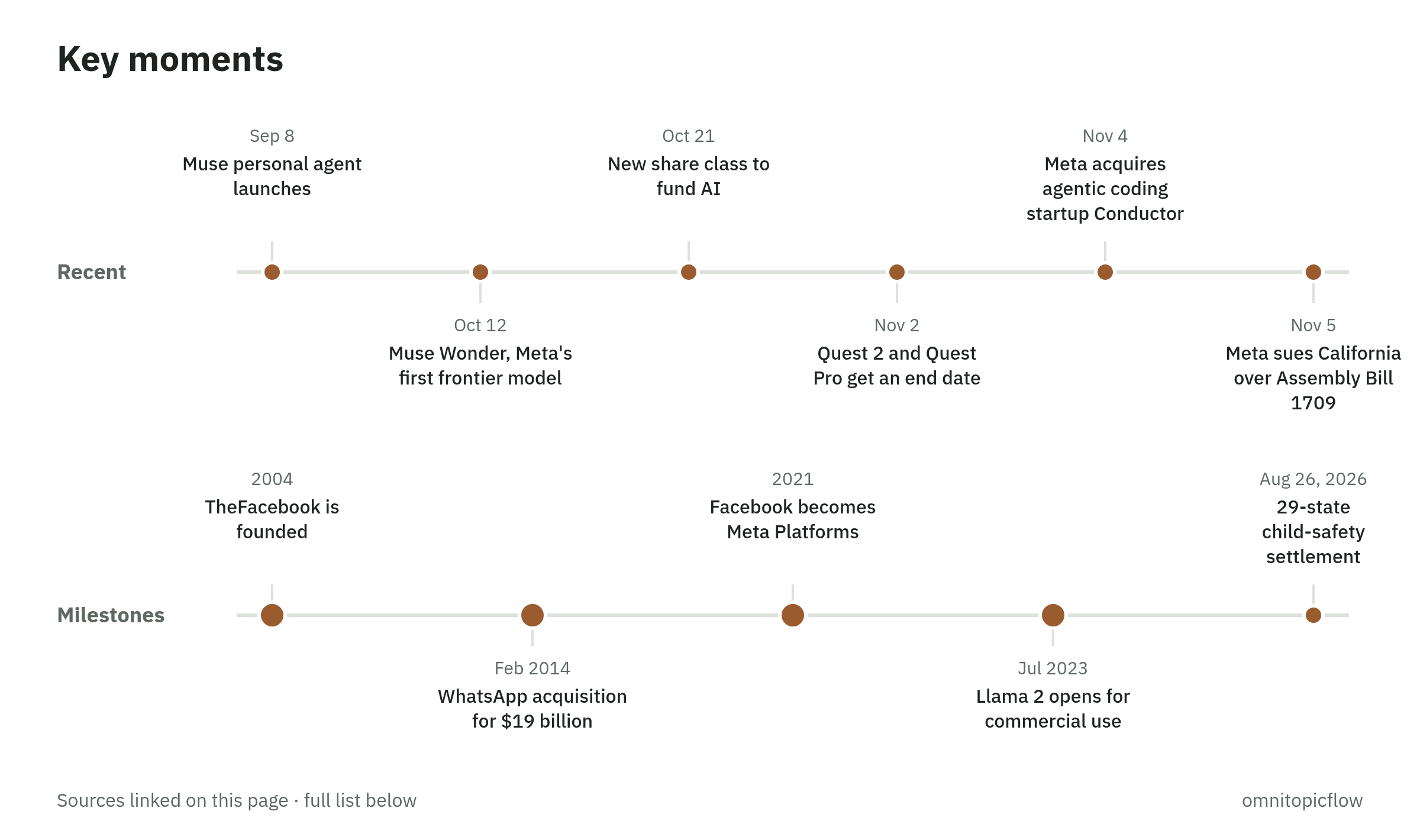
- Nov 5 — Meta sues California over Assembly Bill 1709: Meta joined Google and TikTok in trying to block a law that demands platforms remove “psychologically exploitative features.” Coming after the 29-state settlement, it marks a line: Meta will pay to close old claims but will fight new design rules in court.
- Nov 4 — Meta acquires agentic coding startup Conductor: Conductor's software lets engineers run teams of agents on different parts of a project at once. The deal gives Meta a ready-made developer product team in the middle of its push to catch up on coding models.
- Nov 2 — Quest 2 and Quest Pro get an end date: Meta said the last OS update for both headsets, v213, is planned by March 2027, with security patches and critical bug fixes continuing after that. Owners now have a concrete date for when new features stop.
- Oct 21 — New share class to fund AI: Alongside its third-quarter results, Meta said it would create a non-voting class of stock to pay for AI investment, acquisitions and employee pay. It showed the AI buildout had outgrown what the ad business alone was expected to fund.
- Oct 12 — Muse Wonder, Meta's first frontier model: Meta released Muse Wonder and Muse Wonder Full, larger models it says compete with the industry's best on coding and complex tasks. It marked Meta's claim to be back at the frontier after trailing rivals.
- Sep 8 — Muse personal agent launches: Meta released Muse, an agent that acts on users' behalf across email, calendars and payments. It became the center of Meta's consumer AI push, quickly spreading to iPad, glasses and a dedicated device.
- Aug 26 — 29-state child-safety settlement: Meta settled claims from 29 states that it designed Instagram and Facebook to addict children, for a reported $18 billion. The deal also forces product changes such as a two-hour daily limit for teens, the first time the company accepted usage caps at national scale.
Earlier milestones
- Jul 2023 — ★ Llama 2 opens for commercial use: Releasing Llama 2 for commercial use, with cloud partners including Microsoft, made Meta the leading backer of openly available large language models.
- 2021 — ★ Facebook becomes Meta Platforms: The rebrand signaled a bet on the metaverse and virtual and augmented reality, moving the corporate identity beyond the Facebook app.
- Feb 2014 — ★ WhatsApp acquisition for $19 billion: Buying WhatsApp gave Facebook a global messaging service and remains one of the largest acquisitions in consumer tech.
- 2004 — ★ TheFacebook is founded: The company began in 2004 as TheFacebook, Inc. and took the name Facebook, Inc. a year later, the social network that everything else was built on.
Key numbers
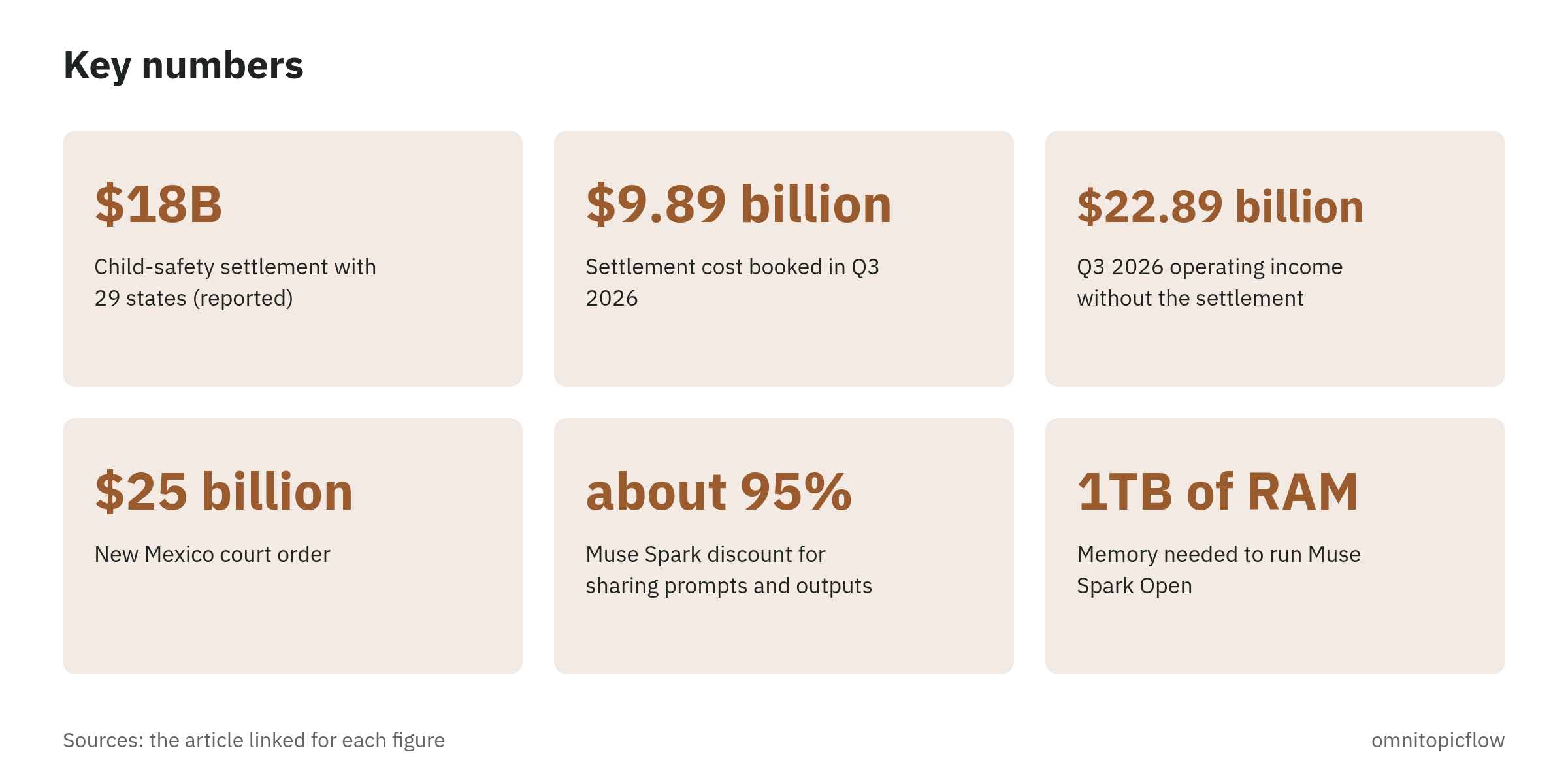
- Child-safety settlement with 29 states (reported): $18B
- Settlement cost booked in Q3 2026: $9.89 billion
- Q3 2026 operating income without the settlement: $22.89 billion
- New Mexico court order: $25 billion
- Muse Spark discount for sharing prompts and outputs: about 95%
- Memory needed to run Muse Spark Open: 1TB of RAM
- Meta VR Glasses price and launch: $1,299, spring 2027
- Edits users: more than 50 million
Stories in progress
- Muse on every surface: Since the September 8 launch, Meta has shipped Muse updates almost weekly: calls, agent email addresses, real-time voice, avatar video chat, an iPad app and a planned glasses integration. Spaces, added in November, goes a step further by letting the assistant build small app-like tools, from a music tracker to a trivia game, inside Muse itself. Muse Charm, the pocket device Zuckerberg teased at Connect, shows Meta wants the agent to live beyond the phone, and the enterprise platform under CJ Desai aims the same tools at businesses.
- Closing the model gap: Meta spent the summer behind rivals and the autumn trying to catch up, keeping its strongest Muse models behind its own APIs while releasing open-weight ones: first Glimmer in August and then Muse Spark Open with Apple in October. Muse Wonder is the first release Meta itself calls frontier-class, and in October Meta and Microsoft were reported to be steering employees away from Claude toward in-house tools. The Conductor deal on November 4 brings in a team built around agentic coding, and it stopped new sign-ups and app downloads that day ahead of a new product planned for early 2027.
- The child-safety reckoning: The 29-state settlement came with product changes as well as money, including daily time caps and overnight limits for teens; Florida rejected the deal as “peanuts.” The New Mexico ruling raised the stakes further, and on October 29 Meta said it would alert parents when teens repeatedly search for self-harm content or talk with Meta AI. California is now the contested ground: Assembly Bill 1709 demands that platforms remove “psychologically exploitative features,” and Meta, Google and TikTok have gone to court to stop it.
- Trust as the price of an agent: Muse asks for access to email, calendars, payments and messages, which makes Meta's privacy record part of the product. Wired found it builds detailed profiles of users' friends and family, Techdirt catalogued security flaws including a Mac zero-day, and Amazon decided it would not let the agent shop on its site, then began letting users text Alexa to shop instead. On training data, Meta dropped a commercial-terms update on November 6 that would have forced Facebook page owners to allow AI training on linked content, while rights holders are demanding more answers about Books3 after testimony that former researcher Stephen Roller torrented and deliberately distributed it.
What to watch
- Whether Muse holds its users once the launch surge fades; TechCrunch noted it started slower than Meta AI or Threads even while ranking near the top of the US charts.
- Whether other large retailers follow Amazon in blocking Muse, or Meta strikes agreements that let the agent shop.
- How Meta responds to the $25 billion New Mexico order and to the remaining state claims outside the settlement, including Florida's, and whether California's Assembly Bill 1709 survives the court challenge and takes effect in 2027.
- What Conductor's team ships in early 2027, and whether Meta's own models become the default for the agent-heavy coding work that product was built around.
- What Meta tells senators about glasses privacy before Meta VR Glasses ship in spring 2027.
Sources
- Google, Meta and TikTok are all suing California to block social media law intended to help kids
- Meta acquires AI coding startup Conductor
- Meta will end Quest 2 OS updates in 2027
- Meta wants to pay for its broad AI buildout with a newly created class of stock
- Meta releases its first frontier model, Muse Wonder
- Meta debuts its Muse AI agent. Will consumers trust it?
- Meta settles for $18B in lawsuit brought by 29 states over social media harms to children
- Llama 2 opens for commercial use
- Meta says it would’ve made over $22 billion if it didn’t have to pay a child safety settlement
- Meta’s $25 billion legal loss just put blood in the water
- Meta is paying to peek at how you use their latest AI model
- Meta built a huge open-weight AI model for Macs, but you'll need 1TB of RAM to run it
- Meta VR 안경
- Instagram's Edits is now on desktop as a Mac app


Comments
Post a Comment
Please read our comment policy before commenting.