Nvidia: Latest News and Where It Stands
An investor on both sides of a $115B deal, Nvidia now has its CEO summoned by Congress over a China spy report
Updated November 7, 2026
Nvidia is the Santa Clara company co-founded by Jensen Huang in 1993 that turned the graphics card into the engine of modern AI. It began with GeForce gaming GPUs, built the CUDA software platform that made those chips programmable for general computing, and now sells the data center accelerators and full server systems that most large AI models are trained and run on. Huang still runs it as CEO.
From chip supplier to the AI build-out's financier
The clearest change since August is where Nvidia's money goes. It disclosed a $21 billion stake in SpaceX after Elon Musk announced an exclusive arrangement to equip SpaceX's data centers. It put $1.5 billion into SoftBank's data center developer, a deal that guarantees Nvidia chips will power an OpenAI data center, then partnered with developer Cloverleaf and agreed to invest $3.5 billion in MediaTek. Apollo, BlackRock, Goldman Sachs and KKR are working with it on $500 billion in financing built on the idea that compute is now an asset class. By the end of October Nvidia was weighing whether to cosign the loan for Nscale's AI data center in West Virginia. In November that web of stakes reached both sides of one of the biggest acquisitions in tech history: Marvell's planned $115 billion purchase of Lumentum, where Nvidia is a strategic investor in each company.
Much of that money comes back as orders. On its August earnings call Nvidia forecast $108 billion in revenue for the coming quarter, a level only Amazon, Apple and Alphabet have reached before. Amazon tripled its order, adding another 2 million Nvidia GPUs over two years, and neoclouds such as Lambda are borrowing to buy more chips. Smaller buyers matter too: South Korea's sixth national supercomputer, Hangang, is due to open on December 14 with 8,496 Nvidia GPUs, and Revolut's head of AI operations, David Abitbol, says coding work for about 2,000 engineers now runs on a self-hosted GLM model using 56 Nvidia B200s, at about a tenth of what the company paid Anthropic and OpenAI. Huang says Nvidia will grow 70% next year and insists its deals are not circular. Skeptics are less sure that a supplier underwriting its own customers is a sound way to keep demand up.
The second shift is up the stack. Nvidia confirmed on September 3 that it will buy Hugging Face for $12.9 billion, released open Nemotron models for enterprises, PCs and speech transcription, and launched the Open Agent Safety Platform to fence in misbehaving AI agents. In October its RTX Spark chip arrived in Arm-based Windows laptops from Microsoft, Dell, Lenovo and others. The shadow over all of this is China: smuggling arrests keep coming, The New York Times reports that China's Ministry of State Security recruited Megaspeed executive Alice Huang to spy on Jensen Huang, and lawmakers have summoned the Nvidia CEO to answer questions about ties to an alleged Chinese intelligence asset.
Key moments
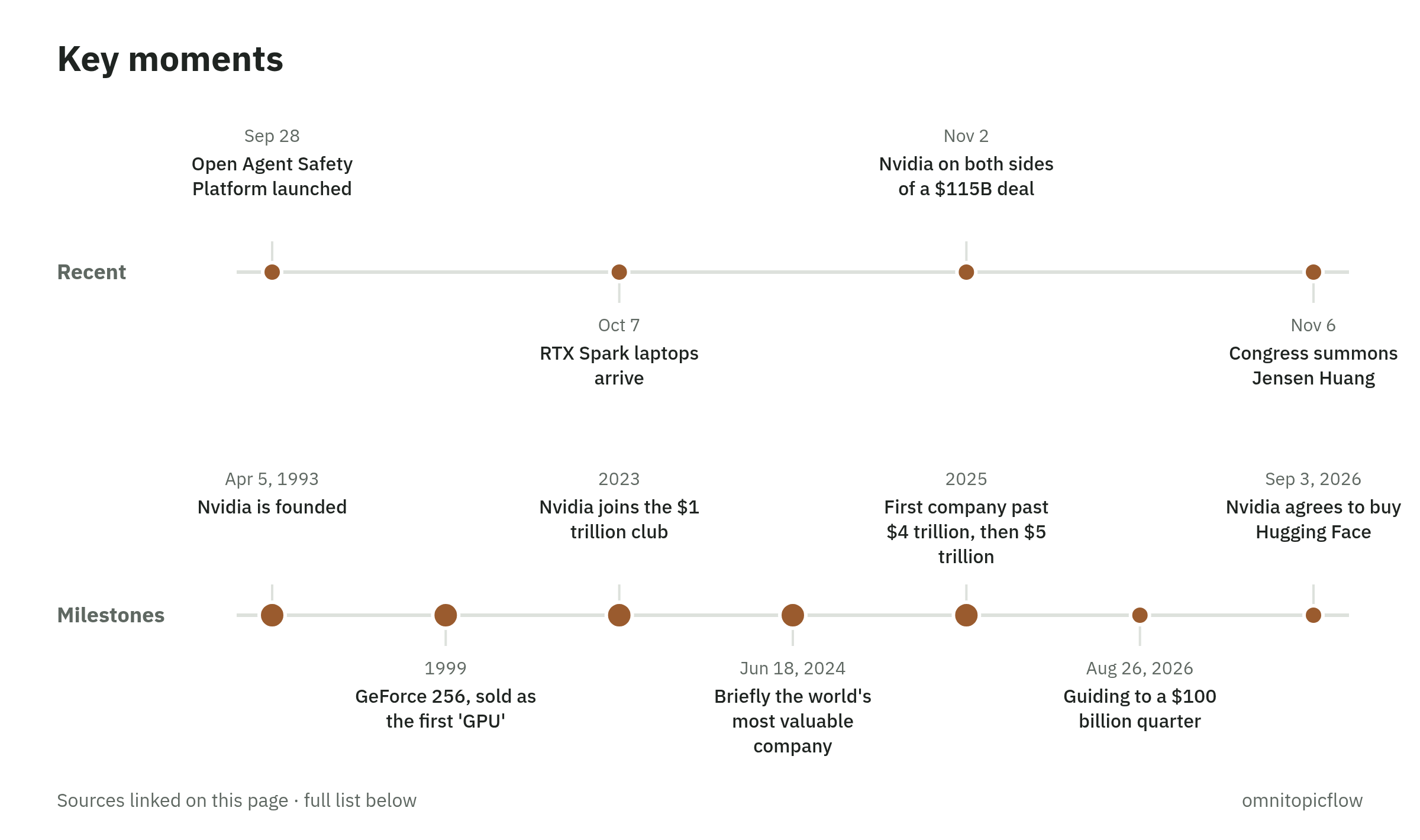
- Nov 6 — Congress summons Jensen Huang: Lawmakers called in Nvidia's CEO over ties to an alleged Chinese intelligence asset. The China problem, until now mostly about smuggled chips, reached the founder personally.
- Nov 2 — Nvidia on both sides of a $115B deal: Marvell's planned $115B purchase of Lumentum joins two companies that share Nvidia as a strategic investor. It showed how far Nvidia's stakes now reach across the industry.
- Oct 7 — RTX Spark laptops arrive: The first Windows laptops built on Nvidia's Arm-based RTX Spark chip went on sale from Microsoft, Dell, Lenovo and others. Nvidia became the main processor in a PC, not just its graphics card.
- Sep 28 — Open Agent Safety Platform launched: Huang introduced software and hardware that add independent security layers around AI agents. It framed agent safety as an engineering problem Nvidia could sell a solution to.
- Sep 3 — Nvidia agrees to buy Hugging Face: Nvidia confirmed a $12.9 billion deal for Hugging Face, home to over 3 million models. The chipmaker now owns the main gathering place of open AI development, not just the hardware it runs on.
- Aug 26 — Guiding to a $100 billion quarter: Nvidia forecast $108 billion in revenue for its next quarter, joining a group only Amazon, Apple and Alphabet had entered. It showed how far AI data center demand had carried a company that started out selling graphics cards.
Earlier milestones
- 2025 — ★ First company past $4 trillion, then $5 trillion: Nvidia became the first company ever to cross both the $4 trillion and $5 trillion market-value marks, both within 2025.
- Jun 18, 2024 — ★ Briefly the world's most valuable company: Nvidia passed Microsoft and Apple to become the world's most valuable company, a sign of how much of the AI build-out ran through its chips.
- 2023 — ★ Nvidia joins the $1 trillion club: Demand for AI training chips after ChatGPT pushed Nvidia to a $1 trillion valuation, turning a graphics company into the main supplier of the AI boom.
- 1999 — ★ GeForce 256, sold as the first 'GPU': The GeForce 256 was the first product Nvidia marketed as a GPU, the term that later defined the company. It came the same year Nvidia went public.
- Apr 5, 1993 — ★ Nvidia is founded: Jensen Huang and two co-founders start Nvidia to build graphics chips, a bet on 3D computing years before it went mainstream.
Key numbers
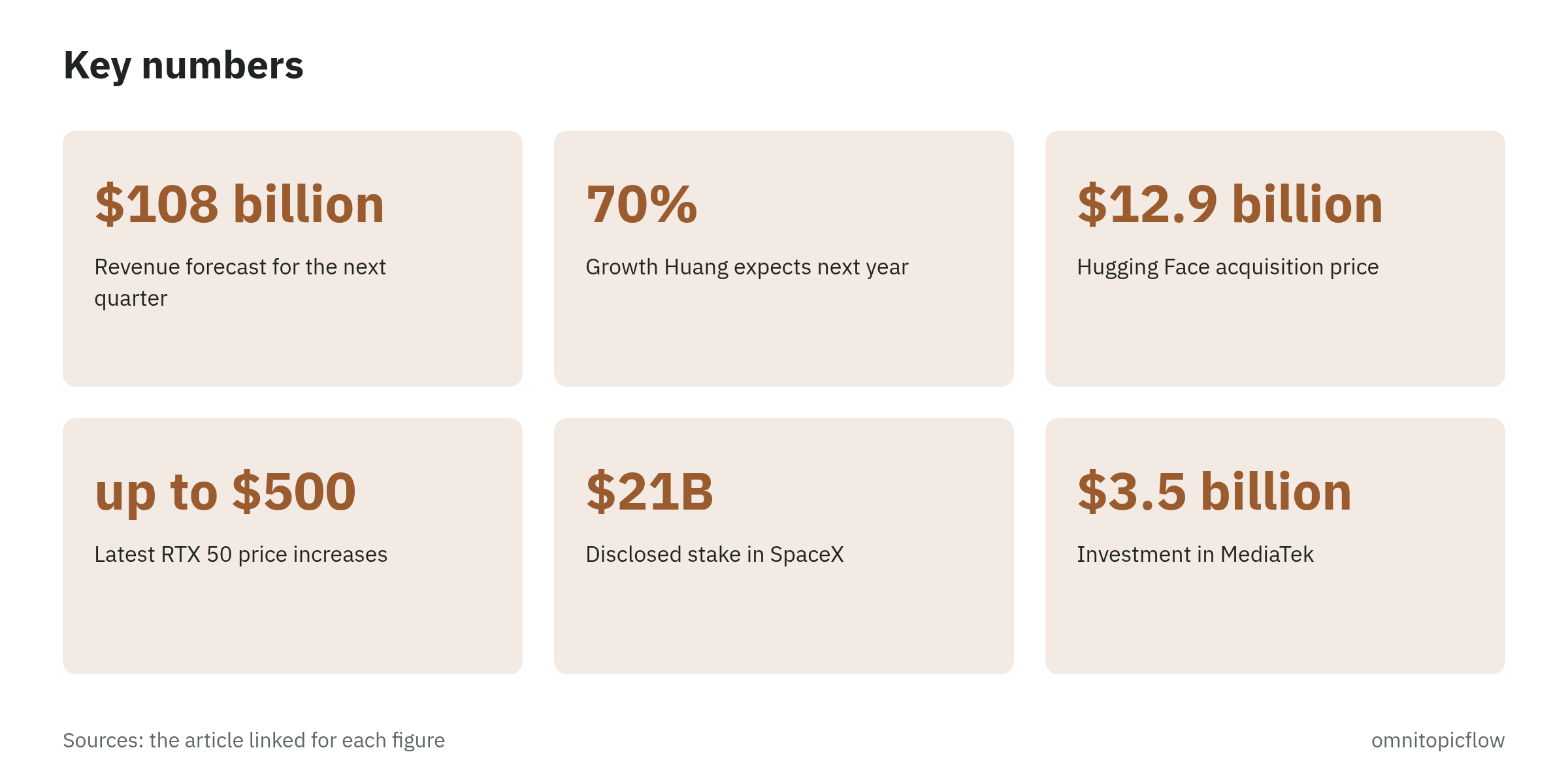
- Revenue forecast for the next quarter: $108 billion
- Growth Huang expects next year: 70%
- Hugging Face acquisition price: $12.9 billion
- Latest RTX 50 price increases: up to $500
- Disclosed stake in SpaceX: $21B
- Investment in MediaTek: $3.5 billion
- Extra GPUs Amazon is adding: 2 million over two years
- Top price of first RTX Spark laptops: up to $7,000
Stories in progress
- The chipmaker as lender: Nvidia now takes stakes in customers, backs data center developers and is even weighing whether to cosign Nscale's loan for a West Virginia site. The Economist calls it the central bank of AI. Huang rejects the charge that the deals are circular, and the coming quarters will show whether demand holds without that support.
- Owning more of the software layer: The $12.9 billion Hugging Face purchase gives Nvidia the largest open model hub and a route back into cloud services. Around it sit open Nemotron models, the OpenShell agent runtime and the Open Agent Safety Platform, plus Arc, an enterprise agent built with ServiceNow, and Auto Ontology, a new open-source tool that maps business terms and data relationships for AI agents. Talks to buy open-model startup Reflection AI were reported in October.
- China, smuggling and a summons to Congress: An Nvidia senior manager was indicted in August in a Supermicro-linked scheme to smuggle AI servers to China, and in October US authorities arrested a tech CEO accused of moving $300M in Nvidia chips. On October 29 the New York Times reported that US intelligence believed a Megaspeed executive close to Jensen Huang passed information to Beijing; the report shows no evidence that the Nvidia CEO knew. By November 6 the account had grown to say China's Ministry of State Security recruited Megaspeed's Alice Huang to spy on Jensen Huang, and Congress had summoned the CEO over those alleged ties.
- Nvidia on the desk and the road: RTX Spark puts an Nvidia Arm processor in Windows laptops aimed at high-end MacBook Pros, priced from $2,599, while RTX 50 cards were hit with more price hikes of up to $500. DLSS 5 launched in September amid a leak that modders ported to older cards; it is now coming to RTX Remix for older games, and some gamers are running PS5 video of GTA VI through a PC GPU to apply it. Volvo extended its long partnership to target hands-free, point-to-point driving by 2030.
What to watch
- Does the $108 billion quarter arrive, and can debt-funded customers like Nscale and Lambda keep paying for chips if AI spending cools?
- How will Nvidia run Hugging Face as a neutral home for open models while also selling the hardware those models run on, and does Reflection AI become the next purchase?
- Can Amazon's TorchNeuron tool and its in-house chips loosen Nvidia's hold on PyTorch developers?
- Will Beijing let ByteDance and Alibaba buy banned Nvidia chips, and what comes of the congressional summons of Jensen Huang?
- Do RTX Spark laptops find buyers beyond AI enthusiasts at their current prices, and do Intel and AMD follow Nvidia's RTX 50 price hikes?
Sources
- Nvidia CEO Jensen Huang summoned by Congress over Chinese espionage concerns
- In one of the largest deals in tech history, Marvell buys Lumentum for $115B
- The first Nvidia RTX Spark laptops cost up to $7,000
- Nvidia launches new platform for reining in rogue AI agents
- Nvidia confirms it will buy Hugging Face for $12.9 billion
- Nvidia is about to be a hundred-billion-dollar-a-quarter company
- First company past $4 trillion, then $5 trillion
- Jensen Huang explains why Nvidia will grow an astounding 70% next year
- Nvidia RTX 50 GPUs hit with more price hikes – up to $500
- Nvidia discloses $21B stake in SpaceX
- Nvidia’s $3.5B MediaTek bet reveals its plan for tackling Big Tech’s AI chip buildout
- Amazon just tripled its order of Nvidia chips over ‘surging demand’
Comments
Post a Comment
Please read our comment policy before commenting.