Tesla: Latest News and Where It Stands
Tesla is trading Cybertruck floor space for Cybercabs as its profit falls 43%
Updated November 7, 2026
Tesla is a US company that designs, makes and sells battery electric vehicles, along with stationary batteries and solar products. It was founded in 2003, and Elon Musk is its CEO. Its vehicle range includes the Model 3 and Model Y.
Car-company earnings, robot-company spending
The clearest signal of Tesla's direction came on November 6, when Elon Musk said on X that Cybertruck production at Gigafactory Texas would wind down around the middle of 2027 to make room for more Cybercabs. The truck was already struggling: Ars Technica described its sales as in free fall when third-quarter deliveries came out in October. Tesla had also repurposed its Model S and Model X lines for Optimus earlier in 2026, so this is the second time this year that car production has given up space to autonomy and robotics.
The financial results explain why this looks like a bet and not routine product housekeeping. Third-quarter revenue was flat at $28.0 billion, profit fell 43% to leave net income at $1.7 billion, and the energy storage business shrank. Deliveries topped 486,000 but came in below the record set a year earlier. Spending is moving the other way, with capital expenditure planned at no less than $25 billion for 2026, compared with $8.5 billion in 2025. On September 29 Tesla also lined up $30 billion in credit from Citi and Wells Fargo, which it says it won't draw on this year.
The businesses receiving that money are still small or unproven. Robotaxis number roughly 1,000, and Tesla has stopped saying how many paid rides they deliver. The Information reported several hundred Optimus robots a week in August against a goal of 20,000, though Tesla said in October that production had begun in California. Federal regulators, meanwhile, are examining both the Cybercab's compliance with vehicle safety standards and complaints about robotaxis speeding through school zones. My read is that the coming year will test whether these projects can grow into the profit source Tesla needs before car earnings weaken further.
Key moments
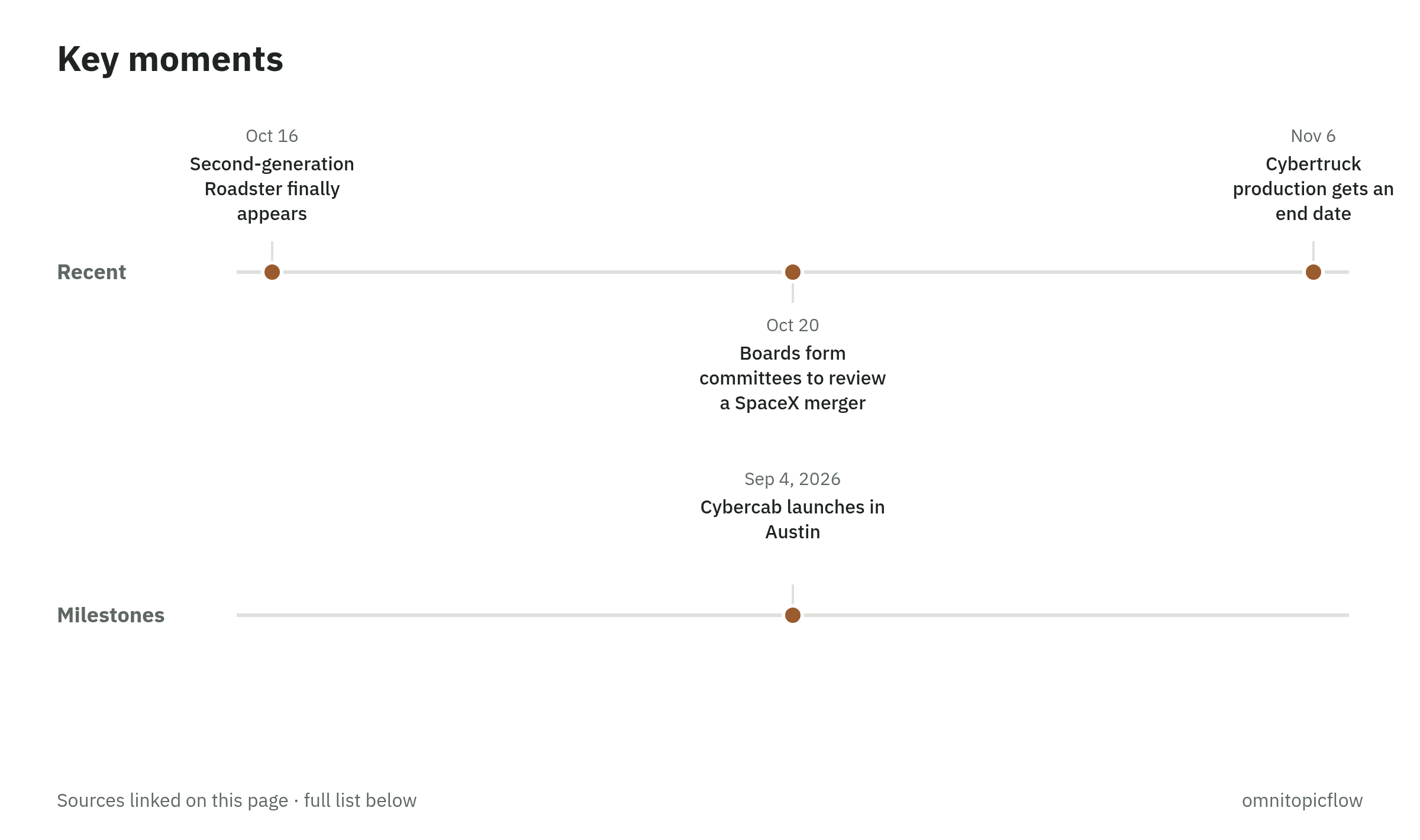
- Nov 6 — Cybertruck production gets an end date: Musk said Cybertruck production at Gigafactory Texas will wind down around the middle of 2027 to make room for more robotaxi output. It marks a plain choice by Tesla to give up one of its best-known vehicles for its autonomy plans.
- Oct 20 — Boards form committees to review a SpaceX merger: SpaceX and Tesla boards set up special committees of independent directors to review a possible merger. Musk publicly favors the idea, which turned a long-running question about his companies into a formal board process.
- Oct 16 — Second-generation Roadster finally appears: After years of delay, Tesla showed the Roadster using thrusters to leap over its own vehicle lineup at a Texas demo. The event drew attention to a long-promised car at a moment when the company's money was moving toward autonomy and robots.
- Sep 4 — Cybercab launches in Austin: Tesla launched its two-seat Cybercab, which has no steering wheel or pedals, at a private event in Austin. The launch put a vehicle at the center of Musk's autonomy bet on public roads for the first time, and a federal investigation followed within hours.
Key numbers
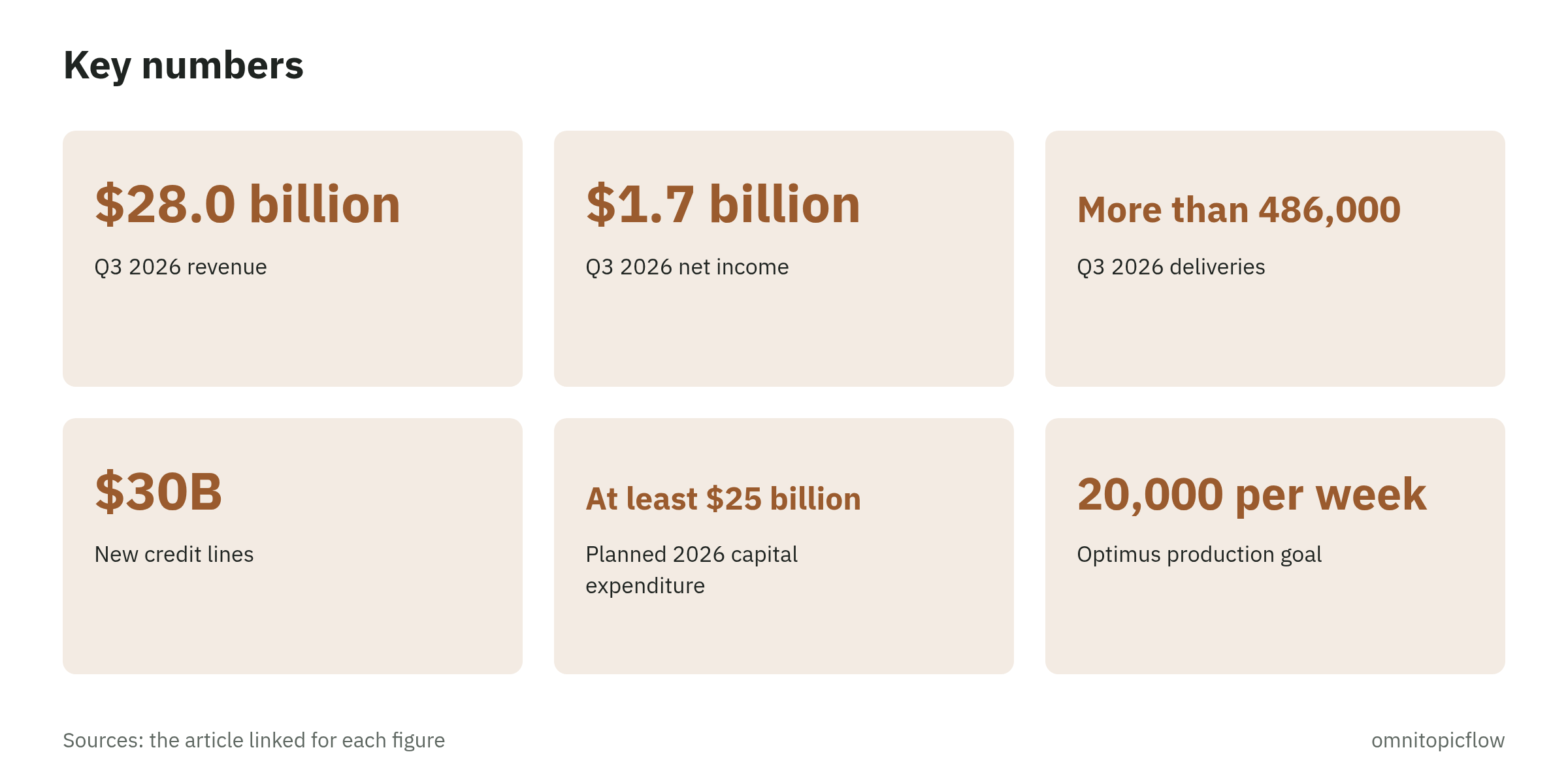
- Q3 2026 revenue: $28.0 billion
- Q3 2026 net income: $1.7 billion
- Q3 2026 deliveries: More than 486,000
- New credit lines: $30B
- Planned 2026 capital expenditure: At least $25 billion
- Optimus production goal: 20,000 per week
- Robotaxis cited in the NHTSA school-zone review: 1,000 or so
- Roadster thruster option reservation: $250,000
Stories in progress
- Cybercab sales begin under a federal cloud: Tesla launched the two-seater without a steering wheel or pedals at a closed-door Austin event on September 4, and a federal investigation into whether it meets vehicle safety standards opened within hours. Less than a week later, riders had found a virtual joystick that allows a form of manual control. Tesla still plans to sell Cybercabs to other transport companies by the end of 2026 and says owners can add their own cars to the robotaxi fleet in 2027.
- A new name in Europe, the same questions at home: On October 9 Tesla renamed Full Self-Driving as Tesla Assisted Driving in Europe, a change Germany's transport minister followed by advocating Europe-wide adoption of the software. In the US, Tesla's federal filings confirmed driver assistance was active in a New Jersey crash that killed 82-year-old Stephen Field, and a California driver said he was asleep using FSD when he hit highway patrol cars. Competition is also closing in, with BMW planning urban driver assist from 2027, starting in Germany.
- Two 2017 promises finally show up: The Semi, first shown as a concept in 2017, reached volume production in April 2026 with a 500-mile range and a stated target of 50,000 units a year, though charging gaps still limit electric trucking. The second-generation Roadster, announced in November 2017, appeared in Waco, Texas, in October, using cold-gas thrusters to leap over a lineup of Teslas. The Verge called the flying stunt just for show, and buyers are already paying reservations that start at $50,000.
- Merger talks with SpaceX: Tesla and SpaceX have formed special committees of independent directors to discuss a possible merger, a process Musk says shareholders requested. Musk, who runs both companies and sits on neither committee, said on October 20 that "I do think there's a lot of merit to combining the companies." The Roadster demo, built with SpaceX technology, offered a small preview of how closely the two already work together.
What to watch
- Can Tesla start selling Cybercabs to other operators by the end of 2026 while the federal safety investigation remains open?
- Will owners actually be able to add their cars to the robotaxi fleet in 2027, now that Tesla has given itself a deadline for a long-repeated promise?
- What will the special committees conclude about a SpaceX merger, and on what terms?
- How far can Optimus output climb from several hundred robots a week toward the 20,000 goal?
- Does Tesla begin drawing on its $30B in credit once 2026 ends?
Our coverage
Sources
- Tesla is ‘winding down’ production of the Cybertruck next year
- SpaceX and Tesla boards form special committees to review merger
- Tesla reveals SpaceX-powered Roadster that flies and falls with style
- The unusually muted Tesla Cybercab launch
- Flying Roadsters can’t lift Tesla’s flat Q3 revenues
- Tesla sustains its EV sales momentum despite US troubles
- Tesla secures $30B in new credit lines as it looks to scale Cybercab, Optimus
- Tesla’s Optimus robot is going through growing pains
- The feds are looking into reports of Tesla’s robotaxis speeding through school zones
- Tesla's redesigned Roadster has a cold-gas thruster option, but you'll need $250,000 just to reserve it


Comments
Post a Comment
Please read our comment policy before commenting.