US Justice Department Links AI and Data Center Opposition to Foreign Agent Rules
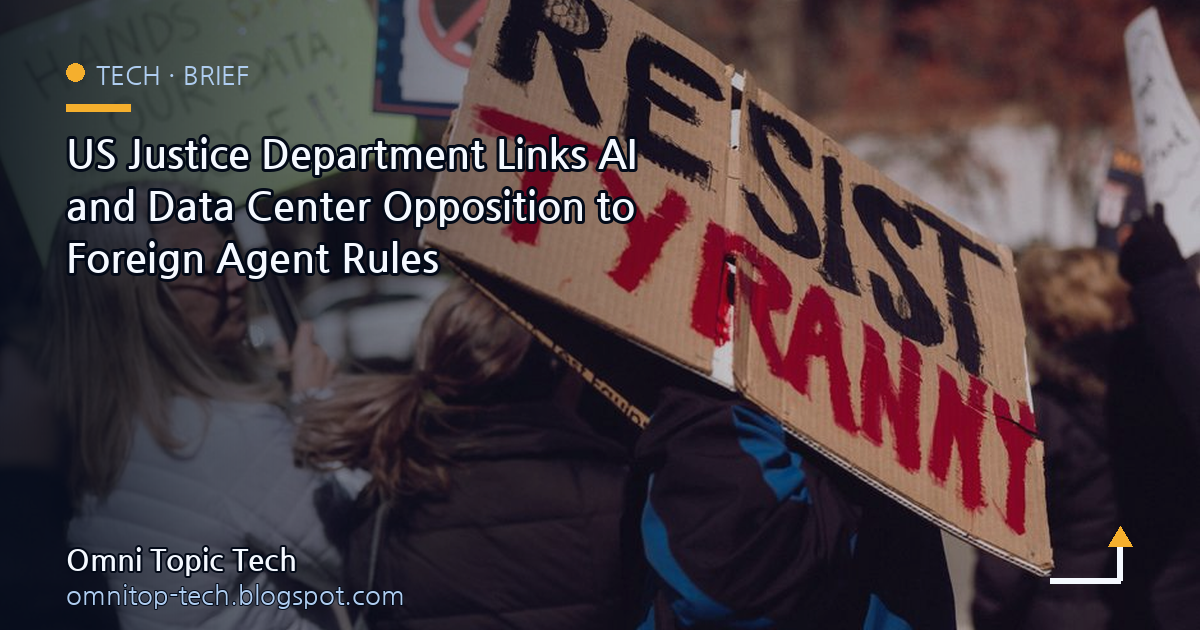
The U.S. Department of Justice has signaled that public opposition to AI development and data center construction could be treated as activity tied to foreign influence, specifically China. Under this framing, groups or individuals whose advocacy is seen as advancing a foreign government's goals may face registration requirements and even criminal liability. Congressional Republican leaders have echoed this stance, calling for investigations into whether foreign actors are behind data center opposition campaigns.

What Happened
The Trump administration's Justice Department has warned that public activism against AI infrastructure and data center projects could trigger obligations under foreign agent disclosure rules if that activism is deemed to align with the interests of a foreign power, namely China. The warning suggests that individuals or organizations engaged in such advocacy could be required to register with the government, and failure to do so could carry criminal penalties.
At the same time, Republican leadership in Congress has called for investigations into whether foreign interference is driving opposition to data center construction across the United States.
Background: Why This Is Emerging Now
Over the past few years, data center construction tied to the AI boom has faced growing local pushback in the U.S. Communities have raised concerns over electricity consumption, water usage for cooling systems, noise, and rising real estate costs near proposed sites. These are largely grassroots, local concerns rooted in infrastructure and environmental impact.
As AI companies push to expand computing capacity rapidly, this local resistance has become a friction point for an industry the administration considers strategically important in the broader U.S.-China technology competition. Framing opposition movements as potentially foreign-influenced appears to be one way officials are attempting to address that friction.
Why It Matters
This development raises questions that extend beyond U.S. borders. For one, it sets a precedent for how democratic governments might respond when infrastructure expansion tied to a strategic industry meets local resistance. If opposition to data centers—typically driven by environmental and community concerns—gets recast as a national security issue, it could chill legitimate civic engagement not just in the U.S. but as a model other governments observe.
For the global tech industry, this also matters because data center siting disputes are not unique to America. Similar conflicts over power grid strain, water rights, and land use are playing out in Europe, Asia, and elsewhere as hyperscalers race to build AI capacity. How the U.S. handles the intersection of activism, free speech, and national security law could influence how other countries frame their own data center approval processes and public consultation requirements.
There's also a First Amendment dimension specific to the U.S. context: civil liberties groups are likely to scrutinize whether tying advocacy to foreign agent registration requirements without clear evidence of foreign coordination oversteps constitutional protections for speech and assembly.
Takeaway
Whether the Justice Department moves from warnings to actual enforcement actions—or whether this remains rhetorical pressure ahead of congressional investigations—will be the key thing to watch. The outcome could shape how AI infrastructure debates unfold not just in the U.S., but in any country grappling with the tension between rapid AI buildout and local community pushback.
Reference: https://www.kenklippenstein.com/p/feds-think-ai-critics-are-foreign


Comments
Post a Comment