Intel Stock Crash Erases $12B From U.S. Government's Stake as AI Demand Drives Up PC Prices
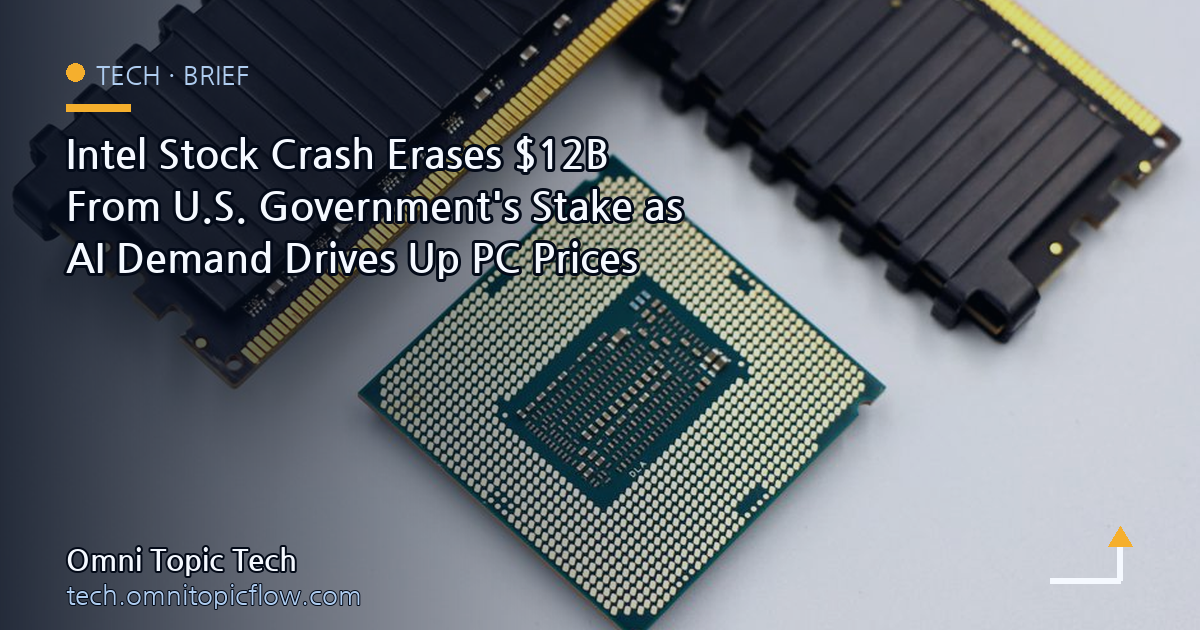
Intel's share price has dropped sharply, taking roughly $12 billion off the value of the stake the U.S. government holds in the company. The pressure point is the PC business. The AI industry is absorbing memory and other components at scale, which pushes PC prices higher and weighs on unit sales.

Intel's latest slide is a useful case study in how the AI build-out spills over into parts of tech that are not directly part of it. The chipmaker is not struggling because of an AI product failure. It is being squeezed by what AI demand is doing to the cost of the PCs its processors go into.
Why the government's stake makes this a bigger story
In August 2025, the U.S. government took a stake of roughly 10% in Intel, converting federal chip-subsidy funding into equity. That decision turned Washington into one of the company's largest shareholders.
As a result, every large move in Intel's share price now shows up as a gain or loss on a public balance sheet. The current drop was big enough to cut about $12 billion from the value of that holding. It is a paper loss, but it makes Intel's share price a matter of industrial policy as well as investor sentiment.
How AI demand ends up in a laptop price tag
A PC needs DRAM for working memory and NAND flash for storage. AI servers need very large amounts of memory too, and memory makers have a strong incentive to prioritize those higher-margin products when they decide how to allocate production capacity.
When that happens, supply available to PC makers tightens and component prices rise. PC makers either absorb the higher cost or pass it on, and both options hurt. Higher sticker prices push consumers and businesses to delay upgrades, which means fewer PCs shipped and fewer processors sold.
Intel is more exposed to this than the companies at the center of the AI boom. Its business leans heavily on PC processors, so a slump in PC demand hits it harder than it hits GPU designers or memory suppliers who benefit from the same demand surge.
How this connects to the infrastructure squeeze
We wrote earlier about how the AI data center boom is forcing a U.S. power grid upgrade. That story was about electricity. This one is about components. The common thread is that AI infrastructure competes with everyone else for scarce inputs. The difference is that grid stress can eventually spur modernization, while a parts shortage mostly shifts costs onto buyers until supply catches up.
What changes for different groups
- PC buyers: Expect higher prices for the same specs, or models that ship with less memory to hold a price point. Comparing RAM and storage across models matters more than before.
- PC makers: Component costs rise at the same time demand softens. That compresses margins unless they can raise prices without losing volume.
- Memory suppliers: The shift toward AI-oriented products supports pricing power. Whether that lasts depends on how quickly new capacity comes online.
- Intel: It has to show that its PC business can hold up while component costs are high, which is a harder story to tell than a growth narrative.
- Policymakers: The government's stake means a weak share price is now politically visible, which could sharpen scrutiny of how chip subsidies translate into results.
What to watch next
The key variable is memory pricing. If supply tightens further, PC makers may keep raising prices and Intel's PC-driven revenue could stay under pressure. If new memory capacity arrives and prices ease, the squeeze could fade. That is an inference from how the cost chain works, not a forecast with a date attached.
Intel's next earnings report should show how much management attributes to PC demand versus other factors. The size of the government's paper loss will keep tracking those results.
Takeaway
Intel's drop shows that the AI boom does not lift all semiconductor companies equally. Firms tied to PCs are paying part of its cost through higher component prices and weaker demand, and the U.S. government, as a roughly 10% shareholder, now feels that directly.
Reference: https://techcrunch.com/2026/10/30/intels-stock-crashes-knocking-12b-from-governments-stake/


Comments
Post a Comment
Please read our comment policy before commenting.