Jet Engine Turbines for AI Data Centers: Buying Years the Power Grid Can't Give

Grid hookups take years and big turbines are backordered, so AI builders are generating their own power with rebuilt aircraft engines. They get speed and give up efficiency.
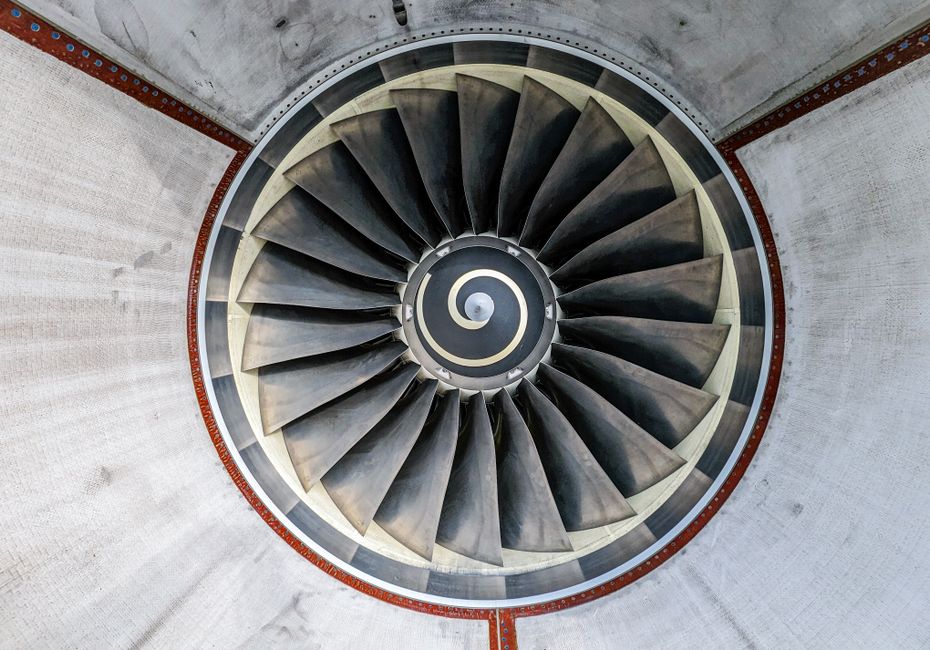
The simplest way to understand why AI companies are bolting retired aircraft engines to their data centers is to put two numbers side by side. Connecting 100 megawatts to the grid in Northern Virginia takes about seven years, according to the International Energy Agency. A jet engine rebuilt to burn natural gas can have a data center running in 24 months, according to Rystad Energy analyst Audun Martinsen. The New York Times laid out the trend on November 3, 2026, and the gap between those two figures explains nearly all of it.
My read is that this is less a story about jet engines than about what has become scarce. For most of the AI build-out, the constraint people talked about was chips. Increasingly it is the date on which electricity actually arrives at a site, and companies are now willing to pay in efficiency and emissions to move that date forward.
The queue for electricity is the real bottleneck
The grid is not the only line builders are standing in. Companies that try to skip the utility and buy their own large gas turbines run into a manufacturing backlog. A Mitsubishi Power executive told Bloomberg that most power capacity is expected to come online by 2031, a sign of how far out turbine orders are now stretching.
The cost of waiting is easiest to see in England. Microsoft pulled out as the anchor customer for Nscale's data center in Loughton after the local utility said it couldn't deliver enough power until the early to mid-2030s. That is the scenario every developer is trying to avoid: a finished or half-finished project with a customer ready to sign, and no electricity to sell them.
Against that backdrop, a converted jet engine is not an exotic choice. It is a way to turn a seven-year wait into a two-year one.
Who is already running on aircraft engines
The best-known example is Elon Musk's xAI, which reportedly installed eight converted jet-engine turbines in Mississippi to help power its Colossus 2 data center in Memphis. Those units come from ProEnergy, a company that rebuilds a GE engine commonly found on Boeing jets and packages it as a generator.
OpenAI went the same way. In 2025 it followed Musk's lead with gas turbines at its first Stargate site in Abilene, Texas. Crusoe, the developer building that campus, ordered 13 of ProEnergy's converted units in April. ProEnergy's announcement describes them as PE6000 aeroderivative generator sets, each capable of producing 50 MW.
The idea has also attracted a company better known for airplanes than power plants. Boom Supersonic, which is developing the Overture supersonic airliner, sells a stationary turbine derived from its jet engine as a data center power plant. Its Superpower unit is rated at 42 megawatts.
None of this is hidden or fringe. The Trump administration has been encouraging data centers to generate their own electricity, which gives on-site generation political cover as well as a business case.
What the speed costs
The trade-off is real and nobody involved disputes it. Converted jet engines are less efficient and pollute more than turbines designed for conventional gas plants. It also takes more of them to produce the same amount of power, which means more units to buy, site and maintain.
That is why some experts describe the approach as a short-term play. Their argument is that efficiency and environmental concerns may grow in importance in a year or two, once the first wave of urgent capacity is in place and operators start looking at fuel bills and emissions over a longer horizon.
There is a reasonable case for the other side, at least for now. If the choice is between a less efficient turbine running in 2028 and an efficient grid connection arriving years later, the first option wins for a company whose customers want compute today. The weakness of that logic is that temporary infrastructure has a habit of becoming permanent. A plant installed as a bridge can stay online for as long as the grid connection keeps slipping.
Crusoe and Boom show how quickly plans change
If demand for on-site turbines is strong, the supplier side is still fragile. In September, Crusoe walked away from a $1.25 billion deal to buy 29 natural gas turbines from Boom Supersonic. Crusoe had been Boom's launch customer, and first deliveries were supposed to begin in 2027.
Crusoe's explanation is the telling part. It said it still plans to use turbines, just not Boom's. In other words, the demand did not go away; one supplier lost the order. For Boom, which hoped its power business would help fund Overture, that is a setback. For the broader market it is a reminder that a headline contract in this space is not the same as a delivered machine.
It also suggests buyers are shopping hard on delivery timing. Crusoe kept its ProEnergy order while dropping Boom's. I would not read too much into one decision, but the pattern fits the rest of this story: whoever can deliver working megawatts soonest gets the business.
A bridge to 2031, not a power strategy
The jet-engine turn is best understood as a bridge. It exists because the grid and the turbine factories cannot keep pace with how fast AI companies want to add capacity, and it will last roughly as long as that mismatch does.
That gives a rough way to watch what happens next. If interconnection times in places like Northern Virginia start to shrink, or if the turbine backlog Mitsubishi Power described clears earlier than 2031, the economics of rebuilt aircraft engines get worse quickly. If those timelines keep stretching, expect more of these units, and expect the efficiency and pollution questions to get louder as the fleet grows.
For now, the companies making these choices have been clear about their priorities. They are not claiming jet engines are the best way to power a data center. They are saying it is the fastest way available, and in this market speed is what they are paying for.


Comments
Post a Comment
Please read our comment policy before commenting.