Apple Watch Siri Recap After 2 Weeks: Who Never Opted In
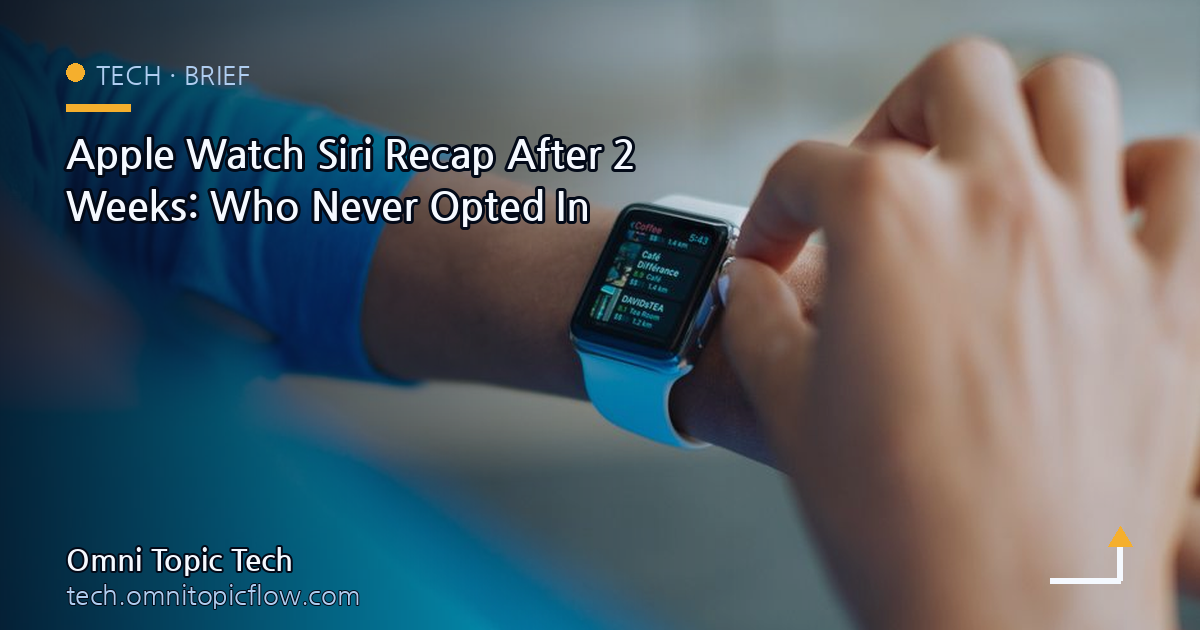
Early testers of Apple's conversation-summarizing watch features have stopped worrying about surveillance and started complaining about clutter. Every one of those testers chose to switch the feature on.

On November 14, CNET published a two-week test of the Apple Watch features that listen to nearby conversations and turn them into notes. By the piece's own framing, the experiment left its author more worried about their sanity than about their privacy. That is roughly where each hands-on has landed since Siri Recap and Live Rewind reached the watchOS 27.3 developer beta on November 3. The fear going in was surveillance. The complaint coming out is clutter.
For Apple this is a reassuring result, and a narrow one. All of these reviews were written by the person wearing the watch, who decided to turn the feature on. The people on the other side of the conversation made no such decision, and two weeks of testing has not changed their position at all.
Three hands-ons, one shared complaint
TechCrunch's Sarah Perez wrote the first of them on November 4, a day into the beta. She had dropped a car at a repair shop and picked up a rental, the kind of errand where details fly past while your hands are full. When she opened Siri Recap later, it had kept the deductible and the repair timeframe. She was won over quickly.
The same recap had also kept household chatter and a plan for what to watch on TV. Perez called that "a stark reminder that the feature was listening in on our everyday conversations." Her wish list followed from it: she wants to swipe away a single bullet point, and to have unrelated topics split into separate notes.
On November 11, 9to5Mac's Ryan Christoffel said he had been testing Siri Recap and "really love[s] it," while conceding it will not be for everyone. He was less sure about Live Rewind, noting that asking a restaurant server to repeat something seems easier than reaching for the watch.
Then came CNET's two weeks and the line about sanity. Read together, the reviews describe a worry that turned inward. Nobody reports feeling spied on by Apple. They report the mild discomfort of seeing how much of an ordinary day is small talk, now itemized.
What the Apple Watch keeps and what it throws away
The wearer's privacy fears faded fast because Apple designed for exactly those fears. Both features are opt-in and limited to the Apple Watch Series 12 and Ultra 4. Apple says it does not identify speakers, does not save raw audio, and does not produce word-for-word transcripts.
Live Rewind is the smaller of the two. Double-press the Digital Crown and the watch shows the last 15 seconds of speech as text. The snippet is deleted after 30 seconds unless you save it. Pressing the crown plays a chime and puts an animation and a microphone indicator on the display, a combination TechCrunch reported is meant to signal to the people nearby that something just happened.
Siri Recap runs in the background on a schedule the wearer sets. It condenses conversations into key points such as dates, deadlines and prices, and the text is processed through Apple's Private Cloud Compute. Unsaved recaps delete themselves within seven days. It can be switched off from Control Center, and it pauses while the wearer has noise-cancelling headphones on.
A great deal gets discarded along the way. The part that survives is a written summary, and that summary contains what the other person said.
The opt-in covers one side of the table
The sharpest objection was written in September, right after the announcement, by Glenn Fleishman at Six Colors. He called Siri Recap "just 'life recording' without the label attached," and he was careful to credit the engineering, describing Apple's safeguards as well thought out against the obvious abuses. His problem was the room, not the chip: "There's no indication to other people that it's running at all, and no one except the user can opt out."
Fleishman also quoted Apple's own guidance for the feature, which begins "Be mindful of those around you" and asks users to consider settings where conversations might be private or sensitive. That is an etiquette request standing in where a consent mechanism would go. His conclusion was that if Apple has to issue the warning, the features should not ship in this form.
Lawyers raised a parallel point the same month. Writing in the National Law Review, Brian J. McGinnis of Barnes & Thornburg argued that "the absence of a saved audio file cannot be treated as the end of the analysis," because interception and recording laws vary by jurisdiction and some states, California among them, require the consent of every party. No court has ruled on whether a summary with no audio behind it counts.
None of this is a knock on the reviewers. A hands-on is a record of the user's experience, and theirs was honest. But a stack of reviews saying "less creepy than I expected" measures the comfort of the person who opted in. It says nothing about the mechanic, the rental clerk or the family members whose words ended up in Perez's bullet points. This fits a wider pattern in which Apple's recent friction is about consent rather than capability. The same 27.3 release cycle brings checks for harmful content on iCloud items shared by public link.
What the December release leaves open
9to5Mac reported on November 11 that watchOS 27.3 will reach all users the following month, which puts the general release in December. The rollout is cautious in ways that suggest Apple knows where the exposure is. According to Engadget, Siri Recap and Live Rewind will initially work only in English, will not be available in the EU, and are subject to daily usage limits.
My argument has limits too. The features are in beta and Apple can still change them. The reviewers' main request, finer control over what a recap keeps, is aimed at the wearer's comfort, but a quick way to delete a bullet point would also remove a bystander's words faster. And the legal questions are, for now, questions. The firmest thing anyone can say is that the statutes were written before a device could summarize a conversation without recording it.
Still, the gap is specific enough to name. Live Rewind announces itself with a sound and a visible indicator. Siri Recap, the feature that listens for much longer, has no equivalent that the other person can notice, at least by Fleishman's account of the announced design. If Apple adds one before December, the consent story changes. If it ships as tested, the reviews that matter will be the ones nobody can write yet: from people who learn afterward that a conversation they thought was passing had been kept as notes on someone else's wrist.


Comments
Post a Comment
Please read our comment policy before commenting.